

How to Choose Quality Home Decor: A 2026 Guide
Table of Contents
- Why Quality Home Decor Matters More Than You Think
- Start With Your Space: Measurements, Scale, and Room Flow
- Durable Home Decor Materials: What Lasts and What Doesn't
- How to Identify Quality Furniture Materials Before You Buy
- How to Mix and Match Home Decor for a Cohesive Design
- Budgeting for Quality Home Decor Without Overspending
- Lighting, Texture, and Sustainability: What Most Guides Skip
- Frequently Asked Questions
Last Updated: September 16, 2026
Why Quality Home Decor Matters More Than You Think
Learning how to choose quality home decor starts with one mindset shift: stop asking what looks good online and start asking what will still look good in five years. This guide covers the measurements, materials, and verification steps that separate pieces worth keeping from pieces you'll replace twice.
Start With Your Space: Measurements, Scale, and Room Flow
Measure first, shop second. Most decor disappointments trace back to a piece that was the wrong size, not the wrong style.
The 3-5-7 Rule and Other Proportion Guidelines
The 3-5-7 rule groups accessories in odd numbers (three, five, or seven) at varying heights to create visual balance on a shelf or mantel. Odd groupings read as intentional; even numbers read as matched sets.
- Wall art should span roughly two-thirds to three-quarters of the furniture beneath it
- A rug should extend at least a few inches under the front legs of surrounding seating
- The main focal point of a room should sit at eye level when you enter
Durable Home Decor Materials: What Lasts and What Doesn't
Durable home decor materials share three traits: honest construction, repairability, and finishes that age instead of flaking. Material composition tells you more about lifespan than marketing copy, and the gap between a decade-long piece and an eighteen-month one comes down to a few inspectable details.

Reading the material label like a buyer, not a browser
Most listings use these five words interchangeably. They are not:
- Solid wood means the piece is milled from a single species throughout. Expect visible grain continuity and weight that feels disproportionate to size.
- Wood veneer is a thin slice of real wood glued over a substrate. It can be high quality, but the substrate underneath determines whether it survives humidity swings.
- Engineered wood covers MDF, particleboard, and plywood. Plywood has cross-grain layers that resist warping; particleboard and MDF swell when wet and strip at screw points.
- Wood finish and wood-look are marketing terms with no defined composition. Treat them as unknown until the seller specifies.
Fabric and textile grades
Upholstery and textiles are graded by abrasion resistance in double rubs (Wyzenbeek or Martindale). Benchmarks: light residential starts around 15,000, general residential near 30,000, heavy residential or commercial past 50,000. Ask for the number, sellers who know their product will have it.
Construction markers that predict lifespan
Run these checks before you commit:
- Press a fingernail into an inconspicuous spot. A deep dent signals soft wood or low-density composite.
- Lift one corner. A piece that twists under its own weight will loosen at the joints over time.
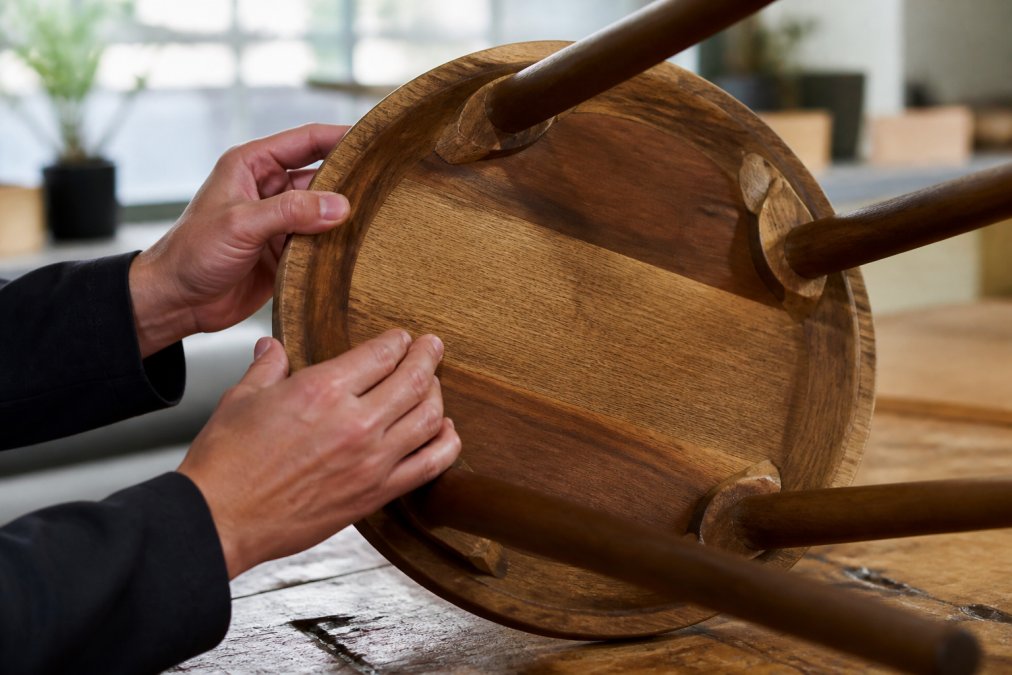
- Look at the underside. Finished undersides and attached hardware suggest a manufacturer expected the piece to last.
- Check the joinery. Dovetail and mortise-and-tenon joints distribute stress; butt joints held by staples or glue alone do not.
- Inspect the finish. UV-coated and sealed surfaces resist fading and moisture far better than bare or waxed ones.
- Look for edge banding. A clean, glued edge on a composite panel resists moisture intrusion; a raw or peeling edge is the first place swelling starts.
Maintenance by material
Maintenance matters as much as material: a well-sealed piece wiped down occasionally outlasts an untreated one.
- Sealed hardwood: dust with a dry microfiber cloth; damp-wipe sparingly; re-oil or re-wax only when the surface looks dry, not on a schedule.
- Veneer: avoid soaking; wipe with a barely damp cloth and dry immediately. Standing water is what lifts veneer.
- Painted or lacquered finishes: mild soap and water, no abrasives. Abrasive cleaners dull the sheen unevenly.
- Natural fiber rugs and baskets: vacuum without a beater bar; rotate periodically; keep out of direct sun to slow fading.
- Metal hardware and frames: dry-dust; a light coat of paste wax on brass or iron slows oxidation.
Repairability is the durability multiplier
A piece you can repair is a piece you keep. Look for tighten-or-replace hardware, removable cushion covers, and spot-repairable finishes. A scratch in solid wood can be sanded and re-oiled; the same scratch in printed veneer usually means replacing the panel, worth more over ten years than any single spec on the label.
How to Identify Quality Furniture Materials Before You Buy
How to identify quality furniture materials comes down to three inspections: joints, weight, and finish. Do all three and you'll catch most problems before money changes hands.
Online Shopping Vetting: Return Policies and Quality Verification
Online shopping vetting means reading the return policy and warranty terms before the product description. If a seller won't state a return window clearly, treat that as information.
A few verification habits that pay off:
- Zoom into listing photos for joinery, edge banding, and hardware
- Read the lowest-rated reviews first; they describe failure modes, not preferences
- Confirm the return window and who pays return shipping
- Check whether the listing states material composition or only a vague descriptor
How to Mix and Match Home Decor for a Cohesive Design
How to mix and match home decor: anchor the room first, then layer outward. Pick one or two anchor pieces that set the tone, then build around them.
Family Love - Crazy, love, loud →
Budgeting for Quality Home Decor Without Overspending
Budget allocation is where quality becomes affordable: spend heavily on pieces you touch daily, lightly on everything else.
A workable split for most rooms:
- Roughly half the budget on investment pieces (seating, tables, anything structural)
- About a third on accent pieces and textiles
- The remainder on home accessories you can swap seasonally
Lighting, Texture, and Sustainability: What Most Guides Skip
Most guides treat lighting, texture, and sustainability as footnotes. They're actually the three variables that decide whether a well-chosen piece reads as quality in your room, and whether it was made in a way you'd stand behind.
Lighting is the quality multiplier
Lighting is the most underrated variable in decor quality. The same piece can look rich or cheap depending on how it's lit: a matte ceramic vase under a bare cool-white bulb looks flat and gray, but under warm, angled light shows depth and glaze variation.
Three layers solve most rooms:
- Ambient light sets the base level, ceiling fixtures, large floor lamps, or indirect cove lighting.
- Task light goes where you work or read, a desk lamp, a reading sconce, under-cabinet strips.
- Accent light grazes texture and highlights the focal point, a picture light, a small uplight behind a plant, a low lamp on a console.
Texture layering that actually works
Mix at least three textures per seating area: something smooth, something woven, something soft. A leather ottoman, a chunky wool throw, and a woven jute rug in one corner give the eye three distinct surfaces to rest on.
A few pairings that hold up:
- Smooth + rough: glazed ceramic beside raw linen or unglazed stoneware.
- Shiny + matte: a brass frame near a matte painted wall, not near another glossy surface.
- Dense + airy: a heavy wood console with a lightweight woven basket or dried stems.
Sustainability and ethical sourcing: what to actually ask
Sustainability claims are easy to print and hard to verify. Rather than chasing a logo, ask questions a maker can answer plainly:
- Where did the material come from? A specific region, mill, or species is a good sign. "Eco-friendly wood" is not.
- How was it finished? Water-based and low-VOC finishes are common in responsible production; ask whether the maker uses them.
- Who made it, and where? Handcrafted and made-to-order production tends to leave a smaller footprint than disposable mass production, and it usually means better material composition disclosure.
- What's the end-of-life plan? Solid wood, metal, glass, and natural fibers can be refinished, repaired, or recycled. Laminated composites often can't.
- Is the certification real? Third-party programs like FSC (forestry), GREENGUARD (low emissions), and GOTS (organic textiles) are verifiable. Self-declared "green" badges are not.
Frequently Asked Questions
What are the signs of high-quality home decor?
Look for solid joinery, consistent finish, and materials that match the price. Real wood shows grain on all faces, not just the front. Metal hardware should feel heavy and operate smoothly. Check that patterns align at seams and that paint or stain covers edges evenly. A piece made from high-quality birch plywood with UV coating, like the wall art from PracticalHomeEssentials.com, signals durability because the maker names the material and the protective finish.
How can I tell if a piece of decor is worth the investment?
Calculate cost per year of use. A $64 wall piece you keep for ten years costs about $6.40 annually, while a $20 item replaced every year costs $200 over the same period. Check whether the material suits your climate and household. Durable home decor materials such as UV-coated birch plywood resist fading and moisture, so they hold up indoors and outdoors. Verify the return policy before buying so a wrong guess does not lock in your money.
What are the best materials to look for in home accessories?
Prioritize solid wood, birch plywood, lead-free glass, and natural textiles over particleboard and thin plastics. Birch plywood is sturdy and lightweight, which makes it easy to hang and move between rentals. Lead-free glass, like the Blue Quicksand Art Glass Ornament, adds visual interest without safety concerns. For upholstery, tight weaves outlast loose ones. Ask how to clean each material before purchase, because maintenance needs vary and affect how long the piece stays presentable.
How do I choose home decor that fits my personal style?
Pull five images you love and note the repeated colors, shapes, and textures. That pattern is your style. Then apply the 70/30 rule: 70 percent of a room in your core palette, 30 percent in accent pieces. When you know how to mix and match home decor, you can buy versatile neutral anchors and rotate smaller items as trends shift. This approach keeps a curated look that travels well when you move.