

Clean Hardwood Floors in Apartments: A Step-by-Step Guide
Table of Contents
- Why Hardwood Floors in Apartments Need a Different Approach
- What You'll Need Before You Start
- How to Mop Hardwood Floors Without Damage
- Best Cleaner for Hardwood Floors: What Actually Works
- How Often to Clean Hardwood Floors in Your Apartment
- How to Remove Stains from Hardwood Floors
- Common Mistakes to Avoid
- Conclusion
- Frequently Asked Questions
Last Updated: October 12, 2026
Why Hardwood Floors in Apartments Need a Different Approach
Hardwood floors add warmth and elegance to any apartment, but cleaning hardwood floors apartments requires a different approach than tile or laminate: hardwood is moisture-sensitive and can warp or swell if exposed to excess water.
Apartments add challenges: limited space, shared walls, and flooring you don't own. Your method must be gentle enough to preserve the finish yet effective for daily wear, the wrong approach can permanently damage the floor and cost your security deposit.
Renters need practical solutions for tight spaces without expensive equipment or harsh chemicals. This guide covers how to clean hardwood floors in apartments, from preparation to maintenance.
The key difference is moisture control. Hardwood expands and contracts with humidity, and standing water seeps between planks, causing cupping, crowning, or warping. Use minimal water and maximum speed.
What You'll Need Before You Start
Before cleaning hardwood floors in apartments, gather the right tools, incorrect equipment often causes more damage than dirt.
Here's what actually works:
- Microfiber mop, captures dust and dirt without scratching the surface
- Dry cloth or vacuum, removes loose debris first (critical step)
- pH-neutral hardwood cleaner, designed specifically for sealed hardwood
- Spray bottle, lets you control exactly how much liquid you use
- Soft-bristled broom, for gentle sweeping before mopping
What you should avoid:
- Oil-based products that leave residue buildup
- Vinegar or baking soda solutions that can dull the finish
- Steam mops that force moisture deep into the wood
- Excessive water of any kind
- Abrasive scrubbing pads that scratch the protective coating
A cordless vacuum helps in apartments where you move between rooms. The Cordless Vacuum Cleaner at $57.99 handles dust and pet hair without the noise of a full-size upright, ideal where neighbors appreciate quiet mornings.

How to Mop Hardwood Floors Without Damage
The correct technique for how to mop hardwood floors in apartments requires restraint: clean without saturating the wood.
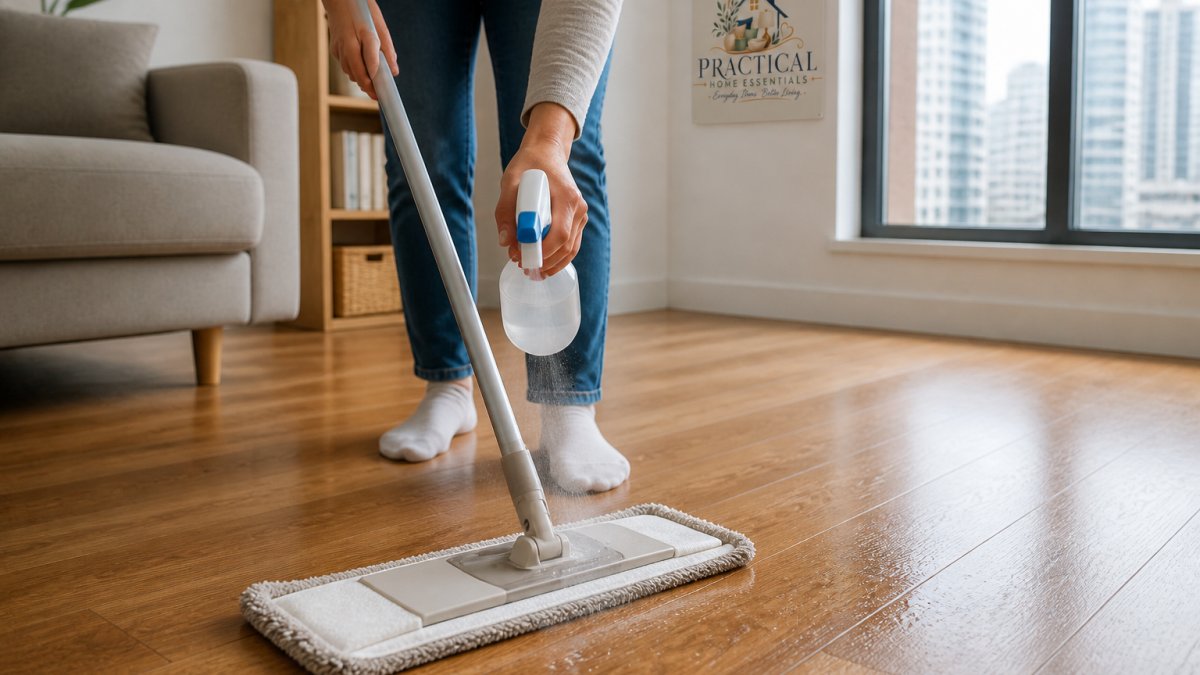
Here's the step-by-step process:
Step 1: Remove all loose debris (5 minutes) Vacuum or sweep thoroughly first. Dust and crumbs act like sandpaper when you mop over them, scratching the finish.
Step 2: Fill your spray bottle with cleaner (2 minutes) Use a pH-neutral hardwood cleaner mixed per package directions, never full-strength.
Step 3: Spray lightly on the mop, not the floor (1 minute per room) Spray the mop head, not the hardwood.
Step 5: Dry as you go (5 minutes) Follow behind with a dry microfiber cloth or towel. This removes excess moisture immediately and prevents water spots.
The process takes 20-30 minutes for a typical apartment; speed minimizes moisture exposure. Don't let the mop sit in one spot, move steadily.
Best Cleaner for Hardwood Floors: What Actually Works
The best cleaner for hardwood floors depends on your floor's finish and your apartment's needs.
Two main types exist:
Oil-based cleaners leave a protective layer but build up over time and can make floors slippery; they suit older, dull finishes.
Water-based cleaners evaporate quickly and leave no residue, making them safer for apartments. Most modern sealed hardwood responds best to water-based formulas.
Look for products labeled for sealed hardwood, with "pH-neutral" or a pH between 7 and 8. Anything more acidic (like vinegar) or more alkaline strips the coating over time.
Avoid "hardwood shine" or "hardwood polish" unless your floor needs it. Most apartment hardwood comes pre-sealed; extra coatings build up and turn sticky and cloudy.
Start simple: plain water first, then a small amount of pH-neutral cleaner if needed. Many apartment floors need only water and a microfiber mop for routine cleaning.
How Often to Clean Hardwood Floors in Your Apartment
In an apartment, three factors change the schedule: you can't vacuum at 6 a.m. without annoying a neighbor, your entryway concentrates outside dirt in a small area, and your lease likely includes inspections. Here's a schedule built around those realities.
The baseline routine
| Task | Frequency | Time |
|---|---|---|
| Dry sweep or vacuum high-traffic paths | 2-3 times per week | 5 minutes |
| Spot-clean spills and sticky marks | Immediately | Under 1 minute |
| Damp-mop with pH-neutral cleaner | Once per week | 15-20 minutes |
| Move furniture and clean underneath | Monthly | 20-30 minutes |
| Full deep clean (edges, corners, under rugs) | Seasonally | 45-60 minutes |
Adjust for traffic, not for guilt
- One or two people, shoes-off household: The baseline above is plenty. Weekly damp-mopping keeps the finish clean without over-wetting it.
- Pets: Add a dry sweep most days. Pet hair and dander act like fine grit underfoot and grind into the finish faster than dust. A cordless vacuum makes this a two-minute job.
- Kids or frequent guests: Bump damp-mopping to twice weekly and spot-clean daily. Crumbs and sticky spills are the main culprits, not general dust.
- Shoes-on household: Sweep the entry path daily. Most of the grit that scratches apartment hardwood walks in through one door.
Timing around your neighbors Shared walls mean noise matters. Vacuum between mid-morning and early evening, and keep motorized cleaning outside your building's quiet hours (commonly 10 p.m. to 7 a.m.; check your lease).
The entryway rule In a small apartment, most tracked-in dirt lands within a few feet of the door.
Seasonal shifts worth planning for
- Winter: Road salt and slush get tracked in and can leave white residue and dull the finish. Wipe entry paths more often and keep a dedicated cloth near the door for quick wipes.
- Spring and summer: Pollen and dust accumulate faster, especially with windows open. Add a dry sweep midweek.
- Humidity swings: Hardwood expands and contracts with indoor humidity. In humid months, run a dehumidifier or air conditioner to keep indoor humidity roughly in the 30-50% range, which is the range most flooring manufacturers recommend for solid and engineered hardwood. In dry winter months, a humidifier helps prevent gaps from opening between planks.
A realistic weekly rhythm If a full schedule feels like too much, this version sticks:
- Monday and Thursday: Dry sweep or vacuum the main paths. Five minutes.
- Saturday: Damp-mop with a pH-neutral cleaner. Fifteen to twenty minutes for a one-bedroom.
- As they happen: Blot every spill; keep a microfiber cloth near the kitchen and bathroom.
- Monthly: Move the couch and bed, clean underneath, and check for new scratches or water marks.
Why consistency beats intensity Frequent light cleaning keeps dirt from embedding in the finish, so you never need the aggressive scrubbing that damages hardwood. It also keeps the floor presentable for surprise walkthroughs.
How to Remove Stains from Hardwood Floors
As a renter, you can't refinish without landlord approval, and heavy-handed fixes can turn a small stain into a deposit charge.
First identify the stain: wipe the area with a damp cloth. If the mark disappears and reappears as it dries, it's on the surface.
Surface stains (most common in apartments) These sit on the protective finish and are the safest to treat yourself.
- Blot immediately with a dry microfiber cloth, blot, don't wipe, which spreads the stain.
- Apply pH-neutral hardwood cleaner to a cloth, not the floor, to control moisture and avoid the finish-stripping that vinegar and baking soda cause over time.
- Wipe gently with the grain.
- Dry immediately with a clean, dry cloth.
If pH-neutral cleaner fails, a little mineral spirits on a cloth can cut grease-based marks like cooking oil or cosmetics.
Water rings and white marks These form when moisture sits on the surface and gets trapped in the finish.
- Start with a dry cloth and light pressure along the grain; many rings lift with nothing more.
- If that fails, a 50/50 mix of distilled water and pH-neutral cleaner on a cloth (never poured on the floor) often works.
- For stubborn rings, a little non-abrasive furniture polish on a soft cloth, rubbed with the grain, can blend the mark. Wipe dry.
- Never use steel wool or abrasive pads, they scratch the finish and leave a dull patch more visible than the ring.
Dark spots, ink, and pet accidents These penetrate the finish, so slow down.
- Pet accidents: Neutralize with an enzyme-based cleaner for hard surfaces, then dry thoroughly. Urine reaching the wood can darken it permanently and may need professional treatment.
- Ink and marker: Rubbing alcohol on a cloth, applied sparingly and dried immediately, sometimes lifts ink from a sealed finish. Test first.
- Dark discoloration in the grain: Usually means moisture reached the wood. Light sanding and spot refinishing is the standard fix, but in a rental this is a landlord conversation, not a DIY project, sanding one spot creates an obvious patch, and a mismatched repair can cost more than disclosing it.
Document before you treat Before applying anything to a stain, take a dated photo of the mark and a wider shot showing its location. If it was there when you moved in, it belongs in your move-in inspection record. If you caused it and can't fully remove it, before-and-after photos help you have an honest conversation with your landlord rather than a disputed one.
Prevention that actually fits apartment life
- Felt pads under every piece of furniture touching the floor, including chairs, plant stands, and TV consoles.
- A washable runner in the highest-traffic path, usually between the kitchen and entry, or from the door to the living area.
- Coasters on side tables and a tray under any plant watered in place.
- Wipe up spills immediately; moisture damage starts within minutes, not hours.
If a stain is beyond surface treatment and you rent, disclose it at move-out rather than attempt an unauthorized repair.
Common Mistakes to Avoid
Knowing what not to do matters as much as technique.
Mistake 1: Using too much water The number-one cause of hardwood damage in apartments.
Mistake 2: Cleaning with vinegar or baking soda regularly Acidic and alkaline respectively, both strip the protective finish over time.
Mistake 3: Skipping the vacuum step Dirt acts like sandpaper.
Mistake 4: Using steam mops Heat and moisture are hardwood's enemies.
Mistake 5: Letting spills sit Moisture damage happens fast. Clean spills immediately. Don't wait for scheduled cleaning.
Mistake 6: Using furniture polish on floors It makes floors slippery and builds up over time.
Mistake 7: Mopping against the grain Water sits in the grain when you mop perpendicular to it.
Individually these seem small, but they compound into cloudy finishes, warping, and permanent damage that affects your security deposit.
Conclusion
Keeping clean hardwood floors apartments doesn't require expensive equipment or harsh chemicals, just the understanding that hardwood is moisture-sensitive and consistent technique. The best way to clean hardwood floors in apartments is the simplest: minimal water, proper tools, and regular maintenance.
Start with what you have: a microfiber mop, pH-neutral cleaner, and patience handle 95% of your hardwood cleaning needs. To simplify your routine, the Cordless Vacuum Cleaner from PracticalHomeEssentials.com ($57.99) makes quick debris removal effortless in compact spaces. With consistent care, your hardwood floors will stay beautiful and protect your security deposit when you move.
Frequently Asked Questions
What is the safest way to clean hardwood floors in an apartment?
The safest way to clean hardwood floors in apartments is to use a microfiber mop with minimal moisture and a pH-neutral cleaner. Avoid excessive water, steam cleaners, and abrasive scrubbing. Always dry the floor immediately after mopping to prevent water damage. For apartments with shared walls or floors, this method also prevents liquid from seeping through cracks into units below.
Can you mop hardwood floors with water alone?
Plain water is not recommended for hardwood floors because excess moisture can cause swelling, warping, and discoloration. If you use water, apply it sparingly with a damp (not wet) microfiber mop and dry the floor immediately. A small amount of water mixed with a pH-neutral hardwood cleaner is safer and more effective than water alone for removing dirt and grime.
How often should you clean hardwood floors in an apartment?
Clean hardwood floors in apartments 1-2 times per week with a microfiber mop and appropriate cleaner. Vacuum or sweep 2-3 times weekly to remove dust and debris that can scratch the surface. High-traffic areas may need more frequent attention. Adjust frequency based on foot traffic, pets, and visible dirt accumulation in your specific space.
Can vinegar damage hardwood floors?
Yes, vinegar can damage hardwood floors. Vinegar is acidic and can strip the finish, cause discoloration, and leave streaks. Even diluted vinegar can seep into wood seams and cause swelling or warping over time. Use a pH-neutral hardwood floor cleaner instead, which is specifically formulated to clean without harming the wood or finish.