

Vacuum vs Robot Vacuum for Small Apartments
Table of Contents
- Vacuum Cleaners vs Robot Vacuums: What Matters in Small Spaces
- Cleaning Performance and Suction Power
- The Best Vacuum Cleaner for Apartment Living
- Robot Vacuum for Small Apartment: Automation vs Manual Work
- Are Robot Vacuums Worth It for Apartments: Cost and Value
- Vacuum Storage Ideas for Small Apartments
- Which Option Is Right for Your Apartment
- Frequently Asked Questions
Last Updated: October 6, 2026
Vacuum Cleaners vs Robot Vacuums: What Matters in Small Spaces
Choosing between a vacuum cleaner and a vacuum robot vacuum small apartment comes down to understanding what each option actually delivers. At PracticalHomeEssentials.com, we focus on real-world performance in tight spaces.
A robot vacuum for small apartment living offers hands-free cleaning on a schedule. A traditional vacuum cleaner gives you immediate control and deeper cleaning power. Neither is universally "better", the right choice depends on your floor types, pet situation, storage space, and how much manual work you're willing to do.
The real tension isn't about which technology wins. It's about matching the tool to your actual living situation. A robot vacuum sitting idle because your apartment layout defeats its navigation is worthless. A cordless vacuum gathering dust because you're too tired to use it defeats its purpose. We'll walk you through the trade-offs so you can decide with confidence.

Cleaning Performance and Suction Power
When it comes to raw cleaning power, traditional vacuums dominate. A corded upright or a high-powered cordless model like the Laresar Elite 8 Cordless Vacuum delivers 450W of power and handles debris, dust, and pet hair with immediate force.
Robot vacuums rely on lower suction power by design, they're constrained by battery life and the need to stay lightweight enough to navigate independently. Most robot vacuums use 1,000-2,000 Pa of suction, while quality cordless vacuums can offer higher suction power. That gap matters on carpet, especially if you have pets or high-traffic areas.
Here's where apartment living changes the equation: most apartment floors are hard surfaces, tile, laminate, or hardwood, mixed with small carpeted areas. Hard floors need less suction force. A robot vacuum handles daily dust and crumbs on hard floors effortlessly. For deeper cleaning, pet hair removal, or carpet treatment, you'll want the power of a traditional vacuum cleaner.
The real performance difference shows up in edge cleaning. Robot vacuums struggle along baseboards and in corners. If your apartment has wall-to-wall carpet or thick rugs, you'll need a traditional vacuum to finish what the robot misses. In a small space, that's often 15-20% of the floor area.
The Best Vacuum Cleaner for Apartment Living
A quality cordless vacuum is the most practical choice for apartment dwellers who want flexibility and power without the hassle of cords. The Laresar Elite 8 Cordless Vacuum at $349.48 represents the sweet spot: 450W power, 55-minute battery life, and a detachable design that works as both an upright and handheld unit.

For apartments, cordless vacuums beat corded models because you avoid dragging cables through tight spaces and outlets. They're lighter than full-size uprights, which matters when you're carrying them up stairs or storing them in a closet.
If you're renting and moving within a few years, a cordless vacuum is also more portable than investing in a full-size system. You can take it with you, and it works in any apartment layout.
The trade-off: cordless vacuums have limited battery life. The 55-minute runtime on the Laresar handles a typical one-bedroom apartment, but larger units or heavily carpeted spaces might require a second charge. For most apartment dwellers, this is a minor inconvenience compared to the convenience gain.
Consider a cordless vacuum your primary tool if you have pets, high-traffic areas, or any carpeting. It's the most reliable way to maintain cleanliness in a small space without relying on automation.
Robot Vacuum for Small Apartment: Automation vs Manual Work
A robot vacuum appeals to the automation fantasy: set it, forget it, come home to clean floors.
Thresholds and floor transitions. Most robots can climb a threshold or transition strip up to about 0.6-0.8 inches high.
Narrow passages. Robots need roughly 12-14 inches of clear width to pass reliably, and some need more to turn. A galley kitchen with a 24-inch walkway is fine.
Furniture clearance. Robots need about 3-4 inches of clearance under furniture to clean beneath it, and they need to physically fit.
Clutter. Cables, charging cords, socks, pet toys, and the legs of dining chairs are the top causes of stuck robots.
Rugs and thresholds between rooms. Low-pile rugs are usually fine.
Navigation type matters more than suction in small spaces. Cameras and LiDAR map the apartment and let the robot clean in efficient rows. Bump-and-random navigation wanders, which wastes battery and misses spots.
Robot vacuums create a false sense of cleanliness. They pick up surface debris but miss what settles under low furniture, in corners, and deep in carpet. Plan on supplementing with manual cleaning monthly, especially if you have pets or allergies.
This hybrid approach costs more upfront, but it matches how small apartments are actually laid out: mostly hard floor, some carpet, tight corners, and a handful of obstacles the robot will never fully solve.
Before buying a robot, do a dry run. Walk your apartment and count: thresholds over 0.6 inches, passages under 15 inches, furniture with under 3 inches of clearance, and loose cables on the floor. If you count more than a few of any, a robot will need regular rescuing, and a cordless stick is the better first purchase.
Are Robot Vacuums Worth It for Apartments: Cost and Value
Upfront price is the least useful number in this comparison. What matters is what you spend over the years you own the device, and how much of the cleaning work it actually removes from your plate.
Laresar Elite 8 Cordless Vacuum, 450W →
Start with purchase price. Robot vacuums generally run from about $200 for entry-level models to $1,000+ for flagship units with self-emptying docks and advanced navigation. Cordless stick vacuums typically range from about $150 to $500, with premium models climbing higher.
Now layer in consumables and replacement parts. This is where the five-year picture diverges:
- Robot vacuum: Replacement filters every 2-3 months, side brushes every 3-6 months, main roller brushes every 6-12 months, and eventually a battery (often $40-$80) after roughly 2-3 years of regular use. Self-emptying docks add bags that need replacing every 30-60 days.
- Cordless stick vacuum: Replacement filters every 3-6 months, a brush roll every 6-12 months, and a battery after roughly 2-4 years depending on charge cycles. Fewer moving parts means fewer failure points.
- Corded vacuum: Bags (if bagged) every 1-2 months, filters every 6-12 months, and belts occasionally. No battery to replace, which is a real long-term advantage.
A reasonable planning assumption is that a robot vacuum costs roughly 15-25% of its purchase price per year in consumables and eventual battery replacement, while a cordless stick runs closer to 10-15%.
Then there is the time math, which is where the value case actually lives or dies. A 600-square-foot apartment takes about 10-15 minutes to vacuum with a cordless stick.
The apartment-specific catch: small spaces are fast to clean manually. The time savings a robot delivers shrink as square footage shrinks.
Budget for the robot's consumables before you buy, not after. The robot has to save you real time to justify that gap.
A useful gut check: if you would not pay a neighbor $5 a week to run a vacuum around your apartment while you are out, the robot's convenience premium is probably not worth it for your situation.
Vacuum Storage Ideas for Small Apartments
Storage is the hidden constraint in apartment living. A full-size upright vacuum needs a closet corner or dedicated cabinet space. A robot vacuum needs a charging dock, which occupies floor space or shelf room.
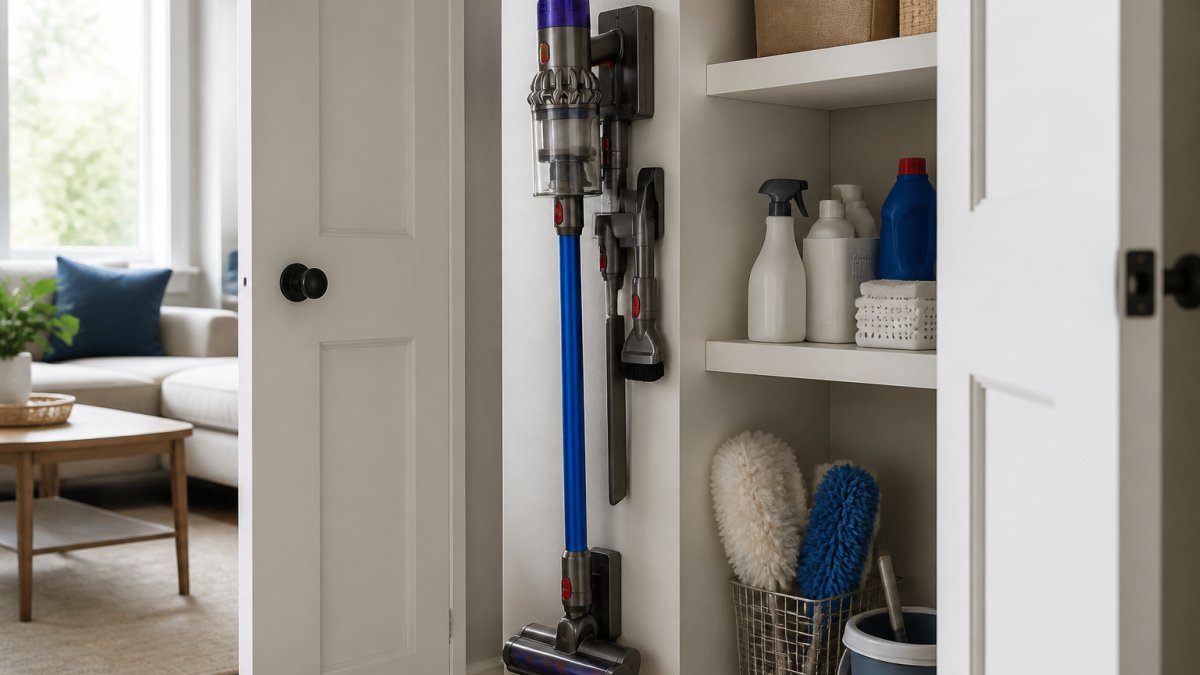
Cordless vacuums are storage winners. Hang them on a wall-mounted rack in a closet, and they take minimal space. The Laresar Elite 8 weighs under 3 kg, making wall mounting practical. Pair it with a small shelf for attachments and filters, and your cleaning tools occupy less than two square feet.
Robot vacuums need a dedicated charging dock. That's typically 2-3 square feet of floor or shelf space, plus clearance around it so the robot can navigate. In a small apartment, that's real estate you might not have.
Here's a practical storage hierarchy for apartments:
- Best: Wall-mounted cordless vacuum in a closet, with a small caddy for attachments
- Good: Cordless vacuum in a corner closet with vertical storage
- Acceptable: Robot vacuum with a charging dock in a bedroom corner (out of sight)
- Avoid: Corded upright vacuum (takes up closet depth and is awkward to store)
If you choose a robot vacuum, measure your available floor space before buying. The dock needs 4-6 feet of clearance on either side to function properly. In a studio or one-bedroom, that might not exist.
Which Option Is Right for Your Apartment
The decision hinges on four factors: floor type, pet situation, storage space, and how much cleaning automation matters to you.
Choose a cordless vacuum cleaner if: You have carpet, pets, or high-traffic areas. You value immediate cleaning control. You're renting and might move soon. You have limited storage space. You want the fastest way to handle a mess.
Choose a robot vacuum if: Your apartment is primarily hard floors. You have minimal carpet and no pets. Your layout is open with few obstacles. You value convenience over cleaning depth. You have 3+ square feet for a charging dock.
Choose both if: You can afford it and have storage space. Use the robot for daily maintenance on hard floors and the cordless for weekly deep cleaning, edges, and carpet.
For most apartment dwellers considering a vacuum robot vacuum small apartment, a quality cordless vacuum is the smarter investment. It handles every floor type, requires minimal storage, works in any layout, and delivers faster results than a robot.
At PracticalHomeEssentials.com, we recommend starting with a reliable cordless vacuum like the Laresar Elite 8. It covers 95% of apartment cleaning needs without the automation complications that plague robot vacuums in small spaces.
Frequently Asked Questions
What is the best vacuum cleaner for apartment living?
The best vacuum for apartments balances cleaning power with portability and storage footprint. Cordless vacuums like the Laresar Elite 8 (450W, 1-hour battery) offer strong suction without cords limiting your reach, making them ideal for navigating small floor plans and furniture. Look for models under 3 kg for easy handling and HEPA filtration to manage dust and pet hair. For apartments with mixed floor types, a multi-nozzle design handles both hard floors and carpet effectively.
Are robot vacuums worth it for small apartments?
Robot vacuums work well in small apartments if your layout is open and free of clutter. They excel at daily maintenance and hands-free cleaning, saving time on routine dust and crumbs. However, they struggle with stairs, thick carpets, and tight spaces between furniture. For apartments under 800 square feet with hard floors, a robot vacuum reduces your cleaning burden significantly. For apartments with heavy pet hair or multiple rooms with thresholds, a cordless or stick vacuum provides better deep cleaning and edge coverage.
How much storage space does a robot vacuum need?
Robot vacuums require dedicated storage for their charging dock, which typically occupies 12-18 inches of wall or floor space. The dock itself is compact (roughly 12x6 inches), but you need clearance around it for the vacuum to navigate back. In small apartments, this often means a corner of the living room, bedroom, or hallway. Consider proximity to outlets and visibility when planning placement. Cordless vacuums take up far less space, they hang on wall mounts or fit in closets, making them better for apartments where every square foot counts.
Can a robot vacuum clean a small apartment effectively?
Robot vacuums handle daily maintenance well in small apartments with open layouts and minimal obstacles. They pick up dust, crumbs, and light pet hair consistently when scheduled regularly. However, they cannot navigate stairs, cannot reach under low furniture, and struggle with long pet hair or thick carpets. They also miss edges and corners. For thorough deep cleaning, you still need a manual vacuum. Many apartment dwellers use both: a robot vacuum for daily upkeep and a cordless vacuum for weekly deep cleaning and spot treatment.
The vacuum cleaner versus robot vacuum decision shouldn't be complicated. In small apartments, cleaning power and storage practicality usually win over automation. A cordless vacuum gives you control, flexibility, and results without the layout constraints that defeat robots. Get started with a quality cordless model from PracticalHomeEssentials.com and experience how much faster apartment cleaning becomes when you have the right tool.