

Budget Office Chair Alternatives That Work
Table of Contents
- Why Budget Office Chair Alternatives Matter
- DIY Ergonomic Chair Hacks for Small Budgets
- Active Sitting Benefits for Your Workspace
- Best Budget Ergonomic Chair Options
- Non-Traditional Seating Solutions for Small Spaces
- Choosing the Right Alternative for Your Height and Workspace
- Common Mistakes When Switching to Alternative Seating
- Frequently Asked Questions
Last Updated: September 19, 2026
Why Budget Office Chair Alternatives Matter
Most remote workers can't justify spending $1,500 on an ergonomic office chair. Budget office chair alternatives deliver the same spinal alignment, lumbar support, and postural benefits at a fraction of the cost, if you know which ones work.
The real problem is finding one that won't leave you with back pain after eight hours. This guide breaks down which budget office chair alternatives genuinely improve your posture and how to set up your workspace for neutral posture without overspending.
DIY Ergonomic Chair Hacks for Small Budgets
Most budget office chairs lack proper lumbar support and force your pelvis into a posterior tilt, rounding your spine over time. The fix doesn't always mean replacing the chair.
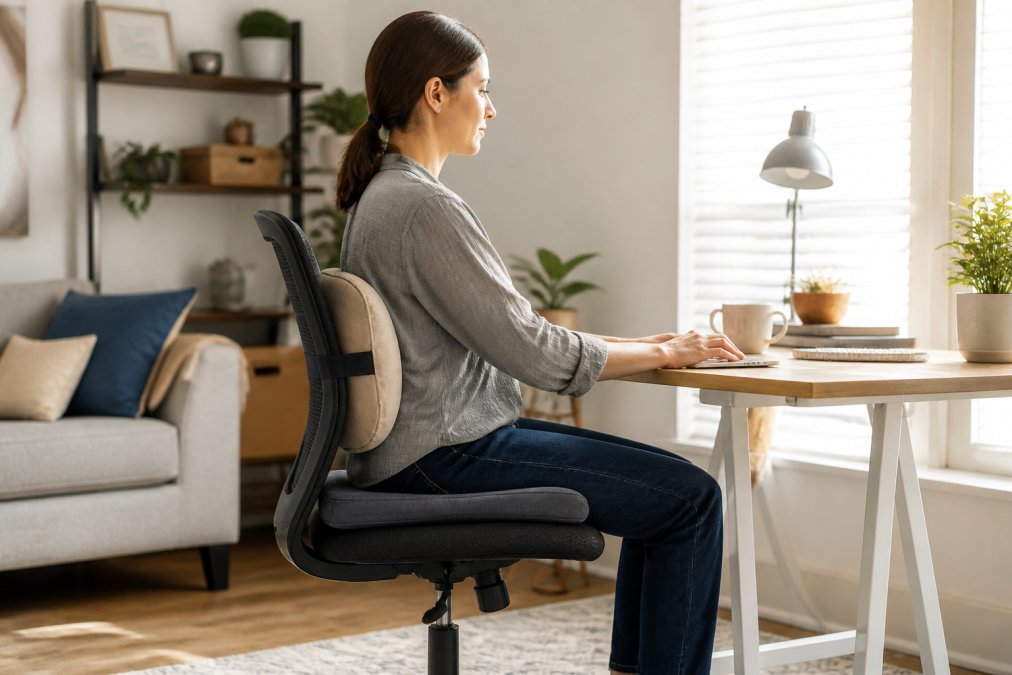
Lumbar Support Modifications
Your lower back needs support at the natural curve of your spine. A $20-40 lumbar pillow placed at the base of your chair's backrest creates that support instantly. The Occupational Safety and Health Administration ergonomic guidelines emphasize that proper lumbar support reduces strain on the lower back during extended sitting.
Look for pillows with adjustable firmness. The Adjustable Bamboo Cooling Pillow from PracticalHomeEssentials.com ($49.00) works as both lumbar support and a repositionable bolster for neck or leg support.

If a pillow feels too soft, roll a towel and secure it behind your lower back. This DIY approach costs nothing and works surprisingly well for maintaining spinal alignment during work hours.
Seat Cushion and Posture Fixes
A thin seat cushion ($15-30) does more than add comfort, it tilts your pelvis forward slightly, which naturally aligns your spine into a neutral posture. This single change reduces postural fatigue significantly.
Pair your cushion with a small footrest or stack of books under your desk to maintain a 90-degree angle at your knees and hips. Your feet should rest flat, not dangle. This weight distribution prevents pressure buildup on your thighs and reduces repetitive strain on your lower back.
Active Sitting Benefits for Your Workspace
Static sitting creates problems: core muscles disengage, hip flexors tighten, and spinal discs compress. Active sitting forces constant micro-adjustments that prevent these issues.
Active sitting isn't a cure-all, it trades one set of demands for another, so understand both sides before committing.
Core Engagement and Spinal Alignment
Sitting on an unstable surface forces your core muscles to fire continuously, strengthening stabilizer muscles and improving body mechanics without dedicated exercise time.
Wobble stools and exercise ball chairs force constant postural adjustment, keeping stabilizer muscles engaged and improving postural endurance, provided you don't exceed your muscular capacity.
Instability triggers proprioceptive feedback, recruiting stabilizer muscles to correct micro-shifts. This repetitive activation strengthens deep core muscles, improving neutral spine position even in static seating.
The Hidden Cost: Muscular Fatigue and Adaptation
Your stabilizer muscles will fatigue faster than expected, and pushing through creates new problems.
Sitting on an exercise ball or wobble stool for 6+ hours causes metabolic waste buildup in stabilizer muscles, triggering lower back soreness, hip flexor tightness, and spinal instability by late afternoon.
Core fatigue is insidious, you don't notice it until your posture collapses suddenly, leaving you slouching on an unstable surface, which is worse than slouching in a static chair.
Your stabilizer muscles need 3-4 weeks of progressive exposure to build endurance for 8-hour sessions. Starting with 6+ hours on day one causes soreness lasting 5-7 days and often leads to abandonment.
Reducing Sedentary Behavior Without Overcommitting
Eight hours in a static chair is still eight hours without movement. Active sitting breaks that pattern through strategic micro-movements.
Study Chair Ergonomic Office Chair →
The most sustainable approach alternates between your primary chair and an active sitting surface every 60-90 minutes.
Best Budget Ergonomic Chair Options
If DIY modifications and active sitting alternatives don't fit your workflow, a budget ergonomic chair can deliver the core features you need without the $1,500 premium price tag. The key is knowing which features actually matter and which are marketing noise.

Essential Features for Budget Chairs Under $400
A functional budget ergonomic chair needs three features: adjustable seat height, a firm seat base, and lumbar support. Everything else is secondary.
Budget Chair Categories and Trade-Offs
Mesh-back office chairs ($150-300) offer breathability but minimal lumbar support. Best for warm environments if you don't mind adding a lumbar pillow.
How to Evaluate Budget Chairs Before Buying
Weight capacity is non-negotiable. Most budget chairs are rated for 250-300 pounds. Exceeding this causes uneven compression and accelerates wear. Check the manufacturer's spec sheet.
The Real Cost of Going Too Cheap
Chairs under $150 often fail within 12-18 months. A $120 chair lasting 18 months costs more per month than a $300 chair lasting 5 years.
Setup Checklist for Your Budget Chair
Once you've selected a chair, proper setup determines whether it delivers ergonomic benefits:
- Adjust seat height so your feet rest flat on the floor with your thighs parallel to the ground and your elbows at 90 degrees when your arms rest on the desk.
- Add a lumbar pillow ($20-40) if the chair's backrest lacks lumbar contouring.
- Position your monitor at arm's length away and at eye level when you sit upright. A monitor that's too low forces you to look down, which rounds your upper spine.
- Use a footrest if your feet don't reach the floor comfortably. A footrest prevents pressure buildup on your thighs and reduces lower back strain.
- Test for 1-2 weeks before deciding. Your body needs time to adapt to a new chair's support pattern. Soreness in the first week doesn't mean the chair is wrong, it means your muscles are adjusting.
Non-Traditional Seating Solutions for Small Spaces
Non-traditional seating delivers ergonomic benefits while saving floor space in small apartments or shared offices.
Exercise Ball Chairs for Core Engagement
An exercise ball ($30-60) forces continuous core engagement by requiring balance on an unstable surface, improving spinal alignment and postural endurance.
Wobble Stools and Dynamic Seating
Wobble stools ($40-100) engage your core while remaining stable for focused work. Constant micro-movements improve body mechanics and reduce postural fatigue.
Choosing the Right Alternative for Your Height and Workspace
Not every alternative works for every body. Your height, weight capacity needs, and workspace dimensions determine which options actually fit your situation.
Adjustable Height Considerations
Measure your desk height first. Standard desks sit at 30 inches. Your chair or stool should position your elbows at roughly 90 degrees when your arms rest on the desk. If your desk is non-standard, prioritize adjustable-height seating that compensates.
Weight Capacity and Base Stability
Check weight capacity limits before purchasing. A wobble stool rated for 250 pounds won't safely support heavier users. Base stability matters too, a narrow base might feel tippy if you weigh more or move frequently during work.
Common Mistakes When Switching to Alternative Seating
Most people fail because they ignore the transition period. Switching suddenly creates muscle soreness that feels like failure.
Frequently Asked Questions
What can I use instead of an office chair on a tight budget?
Several affordable alternatives work well for budget setups. A basic study chair with adjustable height and lumbar support costs significantly less than premium ergonomic chairs. You can also DIY solutions using cushions, bolster pillows for lumbar support, and seat wedges to improve posture on an existing chair. Exercise balls and wobble stools offer active sitting benefits if you alternate between them and other seating throughout the day. The Adjustable Bamboo Cooling Pillow ($49.00) provides ergonomic bolster support for your back or neck, making any seat more comfortable.
Are exercise balls good for sitting at a desk all day?
Exercise balls offer active sitting benefits and core engagement when used correctly, but they shouldn't be your only seating option. Sitting on an exercise ball all day can cause postural fatigue and muscle strain because the constant micro-movements, while beneficial for core activation, demand sustained muscular effort. The best approach alternates between an exercise ball for 20-30 minute sessions and a supportive chair. This variation reduces sedentary behavior while preventing overuse injuries. Exercise balls work best as part of a dynamic seating strategy rather than a full-time solution.
How can I make my current chair more ergonomic on a budget?
DIY ergonomic chair hacks transform an old or basic chair without major expense. Add lumbar support using a rolled towel, foam wedge, or affordable bolster pillow behind your lower back to maintain neutral posture and spinal alignment. Place a cushion on the seat to improve pressure distribution and reduce postural fatigue. Adjust your desk height so your elbows bend at 90 degrees when typing. Use a footrest if your feet don't touch the floor. These modifications address the core issues of neutral posture and proper body mechanics while costing under $50 total.
What is the best budget ergonomic chair for remote workers?
The Study Chair Ergonomic Office Chair ($1,898.98) offers adjustable height, a rotatable base, and cushioned support designed for extended desk work. It features adjustable armrests and a plastic frame that's durable yet affordable compared to high-end ergonomic chairs. For those with tighter budgets, pairing a basic chair with affordable accessories like the Adjustable Bamboo Cooling Pillow ($49.00) for lumbar support and proper desk height adjustment provides solid ergonomic benefits. The key is ensuring your setup supports neutral posture, proper weight distribution, and adjustable height to match your workstation.