

Versatile Furniture for Small Spaces: 10 Smart Picks
Table of Contents
- Quick Comparison: Versatile Furniture for Small Spaces
- 1. C-Shaped Side Table with Faux Marble Top and Storage Shelf
- 2. Under-Bed Storage Drawer with Wheels
- 3. Cabinet Drawer Door Hook for Entryway and Mudroom Storage
- 4. Retractable Clothesline for Small Laundry Rooms
- 5. Pull Out Pots and Pans Organizer for Compact Kitchens
- 6. Surpahs Over-the-Sink Roll-Up Dish Drying Rack
- 7. 4-Tier Bottle Storage Organizer
- How to Choose Versatile Furniture for Small Spaces
- Frequently Asked Questions
Last Updated: September 13, 2026
Quick Comparison: Versatile Furniture for Small Spaces
Versatile furniture for small spaces is any piece designed to serve more than one function or adapt to changing needs without taking up extra floor area. This guide focuses on seven compact picks that fold, roll, stack, or clip into place, because the average apartment simply does not have room for single-purpose pieces. Below, we break down what each one does, what it costs, and who it suits best.
| Product | Price | Primary Function | Best For |
|---|---|---|---|
| C-Shaped Side Table | $157.99 | Surface + storage | Living rooms |
| Under-Bed Storage Drawer | $29.00 | Hidden storage | Bedrooms |
| Cabinet Door Hook | $15.00 | Entryway hanging | Mudrooms |
| Retractable Clothesline | $25.00 | Drying space | Laundry rooms |
| Pots and Pans Organizer | $33.00 | Cabinet storage | Kitchens |
| Roll-Up Dish Rack | $47.00 | Drying + prep | Small kitchens |
| 4-Tier Bottle Storage | $54.99 | Bottle organization | Pantries |
The trick with space-saving furniture ideas is matching the piece to the exact problem. A cluttered countertop needs a different fix than a closet with no hanging room.

1. C-Shaped Side Table with Faux Marble Top and Storage Shelf
This is a highly recommended piece when arranging furniture in a small room without adding visual weight. The C-shaped frame slides under a sofa or chair, so the table occupies space you were not using anyway.
The faux marble top holds up to 66 lbs, and the lower shelf takes another 22 lbs (cpsc.gov). That two-tier design means a lamp, a drink, and a stack of books all have a home without a separate bookshelf. The 1-inch low-profile base is a key detail: it fits under most sofas.
Rounded corners make it safer around pets and kids, and adjustable foot pads keep it stable on uneven floors. Assembly is required, and at 15 lbs net weight, one person can move it alone.
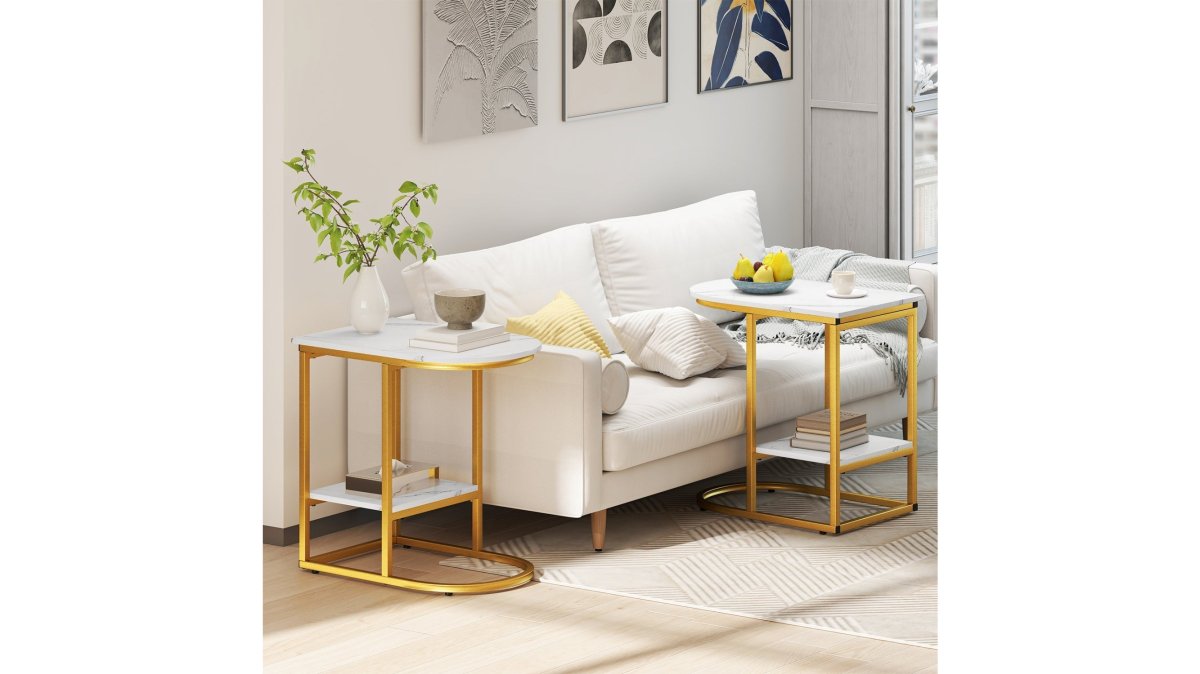
Pros: Slides under furniture, two storage tiers, stable on uneven floors Cons: Requires assembly, faux marble needs gentle cleaning
2. Under-Bed Storage Drawer with Wheels
Bedrooms waste more space than any other room, and the under-bed zone is almost always empty. This drawer rolls into that gap and gives you a clear window and label slot so you can see what is inside without pulling it out.
At $29.00, it handles clothes, shoes, blankets, books, or toys. The fabric body keeps it light enough to slide on its own wheels, which matters if you are storing heavier items. Pair it with a bed skirt and the whole thing disappears.
Pros: Rolls easily, visible contents, multipurpose Cons: Fabric body, not for very heavy loads
3. Cabinet Drawer Door Hook for Entryway and Mudroom Storage
Entryways in small apartments rarely have a closet, so coats and bags end up on chairs. This ABS resin hook clips onto a cabinet or drawer door with no tools and no drilling, which makes it a genuine option for renters.
It weighs 80g and holds coats, clothes, bags, keys, scarves, or shopping bags. The clip-on design means you can move it between rooms whenever your routine changes.
Pros: No tools, renter-friendly, repositionable Cons: Weight limited by the door, not the hook
4. Retractable Clothesline for Small Laundry Rooms
Laundry space disappears fast in a compact apartment. This wall-mount clothesline extends to 188.98 inches and retracts with one touch when you are done, so it takes up wall space instead of floor space.
The heavy-duty metal construction handles regular use, and the one-touch retract-and-lock mechanism keeps the line tidy between loads. It works in bathrooms, balconies, and dorms where a full drying rack would block the walkway.

Pros: Long drying line, retracts flat, wall-mounted Cons: Needs solid wall mounting, indoor drying adds humidity
5. Pull Out Pots and Pans Organizer for Compact Kitchens
Kitchen cabinets lose most of their usable depth to stacked cookware. This organizer pulls out on damping guide rails and uses 8 adjustable dividers to hold pots, lids, pans, cutting boards, and sheet pans upright.
It supports up to 44 lbs and installs with adhesive strips, no drilling.
Pros: Tool-free install, adjustable dividers, quiet glide Cons: Cabinet size requirements, adhesive needs a clean surface
6. Surpahs Over-the-Sink Roll-Up Dish Drying Rack
Counter space is the scarcest resource in a small kitchen, and this rack borrows the sink instead. It rolls out over sinks up to 19.5 inches wide and rolls up for storage when the dishes are done (nsf.org).
The FDA food-safe silicone and steel rods handle heavy pots without bending, and the rack withstands temperatures up to 400°F, so it doubles as a trivet. It also works as a colander for rinsing produce and a cooling rack for baked goods.
Pros: Rolls up flat, heat resistant, food-safe Cons: Sink-width dependent, hand wash recommended
7. 4-Tier Bottle Storage Organizer
Bottles are awkward to store because they roll, and this stackable organizer solves that with anti-slip strips and individual compartments. Each rack holds three bottles horizontally, and four tiers hold up to 12.
The transparent PC construction is shatter-resistant and lets you see what you have without unpacking the shelf. Assembly takes under five minutes, and you can build it as one, two, three, or four layers depending on your cabinet height.
Pros: Stackable, anti-slip, transparent Cons: Hand wash only, not dishwasher safe
How to Choose Versatile Furniture for Small Spaces
Start with the problem, not the product. Walk through your home and note where clutter actually accumulates: the entryway floor, the kitchen counter, the space under the bed. That list tells you which pieces will earn their place.
Measure the Three Dimensions That Matter
Most furniture returns happen because of a single missed measurement. Before you buy anything, capture these three numbers for every spot you want to fill:
- Clearance height. Under-bed drawers typically need 4 to 6 inches of frame clearance. Platform beds with built-in storage will not accept an add-on drawer.
- Cabinet interior depth. Pull-out organizers need a minimum of 20 inches of depth and 10 inches of width to glide without hitting the door frame.
- Sink span. Roll-up dish racks are sized to the sink opening, not the counter. Measure the widest point of the basin, not the rim.
A common pattern is to buy the piece first and then discover the gap is 1 inch too short. Measure twice, order once.
Match the Piece to the Job It Replaces
Every versatile piece should replace at least two single-purpose items. If it only does one job, it is not saving you space, it is just occupying it in a different shape.
- A C-shaped side table replaces a coffee table plus a bookshelf.
- A roll-up dish rack replaces a drying rack, a colander, and a trivet.
- A pull-out pots and pans organizer replaces a lid rack plus a stack of nested cookware.
Write down the two items each candidate replaces. If you cannot name two, keep looking.
Prioritize Ergonomics, Not Just Aesthetics
Most small-space guides focus on how furniture looks. Fewer address how it feels after an hour of use. When a desk doubles as a dining table, or a dining table doubles as a workstation, posture suffers unless you plan for it.
- Seat height versus surface height. A standard desk surface sits 28 to 30 inches high. A standard dining table sits 28 to 30 inches high as well, which means a dining chair works as a desk chair, but only if the chair has adjustable height or a firm cushion.
- Monitor and laptop angle. On a multipurpose surface, raise the screen so the top of the display sits at or slightly below eye level. A stack of books works as a riser if you do not want to buy a stand.
- Foot support. If your chair leaves your feet dangling, add a footrest or a low box. Unsupported feet are a common cause of lower-back fatigue during long sessions.
A common pattern among remote workers in compact apartments is to alternate between sitting and standing every 30 to 45 minutes. If your furniture cannot support that switch, plan a standing break elsewhere.
Maintain the Moving Parts
Transforming furniture lives or dies by its hinges, pistons, and tracks. These are the components that fail first, and they are also the easiest to maintain.
- Drawer rails and glides. Wipe with a dry cloth monthly. Apply a light silicone-based lubricant, not oil, every six months. Oil attracts dust and turns into grit.
- Retractable clotheslines and cord reels. Extend fully and retract slowly. Snapping the line back at full speed wears the spring mechanism.
- Folding and nesting hardware. Check screws and bolts every few months. Vibration from daily folding loosens them faster than static furniture.
- Adhesive-mounted organizers. Adhesive strips lose grip over time, especially in humid rooms. Re-press them every few months, and keep the surface clean and dry.
Keep the original hardware bag and instruction sheet. Replacement hinges and pistons are often proprietary, and having the part number makes warranty claims and reorders far easier.
Consider Material Longevity and Sustainability
Small-space furniture gets handled more than full-size furniture, it folds, rolls, stacks, and slides daily. That means material choice matters more, not less.
- Solid wood and plywood hold up better at hinge points than particleboard, which can crumble when screws are removed and reinserted.
- Powder-coated steel resists chipping better than painted finishes on rolling frames.
- FSC-certified wood and recycled-content metals are increasingly common at mid-range price points and signal a longer intended service life.
- Avoid single-use plastics in load-bearing parts. They crack under repeated stress.
If a piece is designed to be repaired rather than replaced, it is almost always the better buy for a small space, because you will handle it more often.
Buy for Two Jobs, Then Verify the Third
Three rules keep the decision simple:
- Measure first. Cabinet depth, bed clearance, and sink width all determine what fits.
- Buy for two jobs. Every piece should do at least two things, which is what makes it worth the footprint.
- Verify the third job. The best versatile pieces quietly do a third thing, a trivet that becomes a cooling rack, a side table that becomes a step stool, a storage ottoman that becomes extra seating. Look for that bonus function before you commit.
For a broader look at how furniture standards and safety guidance apply to home products, the Consumer Product Safety Commission home safety resources publishes guidance worth checking before you buy.
Frequently Asked Questions
What is the best versatile furniture for small spaces?
The best versatile furniture for small spaces serves at least two purposes. A C-shaped side table with a storage shelf works as both a surface and a shelf. An under-bed storage drawer adds storage without using floor space. A roll-up dish drying rack collapses when not in use. Look for items that fold, roll, stack, or slide away so your floor plan stays flexible.
What is the 2/3 rule for furniture?
The 2/3 rule suggests that furniture should occupy no more than two-thirds of a room's floor space, leaving one-third open for walking and breathing room. In a small room, this means choosing compact pieces like a C-shaped side table that slides under a sofa rather than a full coffee table, or a wall-mounted desk instead of a freestanding one.
How do you choose versatile furniture for a small apartment?
Measure your space first, including doorways and corners. Choose multifunctional furniture for apartments that stacks, folds, or rolls. Prioritize vertical space with wall-mounted hooks and shelving. Pick pieces that work in more than one room, like a storage drawer that fits under a bed or a side table that doubles as a nightstand. Check dimensions against your floor plan before buying.
What are some space-saving furniture ideas for a studio?
For a studio, focus on vertical storage and hidden storage. Use wall-mounted hooks for bags and coats, under-bed drawers for off-season clothes, and a C-shaped side table that tucks under furniture. A retractable clothesline replaces a bulky drying rack. Stackable food containers and bottle organizers free up kitchen cabinets. Keep surfaces clear by choosing furniture with built-in storage.
How do you arrange furniture in a small room to make it feel bigger?
Start by identifying the room's main focal point, like a window or a sofa. Pull furniture away from walls slightly to create depth. Use a C-shaped side table that slides under seating to save floor space. Keep pathways at least 30 inches wide. Choose dual-purpose pieces like a storage ottoman or a wall-mounted desk. Leave one-third of the floor open to avoid a cramped feel.