

Small Apartment Organization on a Budget: 2026 Guide
Table of Contents
- Why Too Many Choices Make Small Apartment Organization Feel Impossible
- The 3-Box Method: Decluttering Tips for Small Spaces Without the Overwhelm
- Small Apartment Storage Hacks That Cost Under $50
- How to Maximize Closet Space in a Tiny Apartment
- Budget-Friendly Kitchen and Entryway Organization
- Rental-Friendly and Pet-Friendly Storage Solutions
- Conclusion: Start With One Zone, Not the Whole Apartment
- Frequently Asked Questions
Last Updated: September 17, 2026
Why Too Many Choices Make Small Apartment Organization Feel Impossible
Small apartment organization fails most often because of too many choices, not too little space. When every store aisle and search result offers a hundred options, the brain freezes, and nothing gets done. That is the real barrier.
The fix is not more products. It is fewer decisions.
So here is the good news: you do not need to organize everything at once.
The 3-Box Method: Decluttering Tips for Small Spaces Without the Overwhelm
The 3-Box Method is a decluttering system that sorts every item into one of three boxes: Keep, Donate, or Store. It removes the endless "maybe" pile that stalls most decluttering sessions.
What to Purge, What to Keep, What to Store
- Purge: Anything broken, unused for a year, or duplicated
- Keep: Items used weekly that fit your current space
- Store: Seasonal or sentimental items you rarely need
Once a box is full, act on it the same day. Donate it, store it, or put it away. Leaving boxes sitting around creates new clutter.
Small Apartment Storage Hacks That Cost Under $50
Affordable storage hacks work best when they use vertical space and hidden areas you already have. The goal is simple: get items off the floor and out of sight without drilling into walls.
Vertical Storage and Over-the-Door Organizers
Wall-mounted shelves and over-the-door organizers turn empty wall and door space into real storage. A basic over-the-door rack holds shoes, cleaning supplies, or pantry items for well under $50. Command-style hooks work in rentals because they leave no holes.
Under-Bed Storage and Hidden Storage Solutions
Under-bed storage is the most underused space in a small apartment. Collapsible storage bins slide right under the frame and hold off-season clothes, extra bedding, or shoes. Look for bins with handles and a dust cover so items stay clean.
How to Maximize Closet Space in a Tiny Apartment
Closet organization fails for the same reason the rest of the apartment does: too many micro-decisions. The fix is to run the closet through a fixed sequence so you are never choosing between options mid-task. This is the decision-fatigue angle most closet guides skip, and it is the reason people stall halfway through a purge.
The One-In, One-Out Closet Rule
Before you buy a single hanger or bin, commit to one rule: for every item that enters the closet, one item leaves. This is the simplest inventory-management system for a small space, and it prevents the slow re-cluttering that undoes a weekend of work. Keep a single "out" bag by the closet door. When it fills, it goes to donation that week.
A Fixed Four-Step Sequence (No Choices Allowed)
Run these in order. Do not skip ahead, and do not stop to shop for products until step four.
- Empty and sort by category, not by sentiment. Pull everything out and group into tops, bottoms, outerwear, shoes, and accessories. Sorting by category removes the emotional pull of individual pieces.
- Apply the one-year test. Anything not worn in the last 12 months goes in the out bag, with two exceptions: formal wear and true seasonal items. Two exceptions max, more than that and the rule collapses.
- Rebuild top-down. Put back only what survived, starting with the highest shelf and working down. This forces you to use the top two feet most closets waste.
- Add one tool, then stop. Pick a single upgrade for the week. Adding three tools at once is what creates the overwhelm you are trying to escape.
Rental-Safe Ways to Double Hanging Space
Most closets waste vertical height because the original rod sits at a fixed height. You can reclaim that space without drilling:
- Add a second tension rod below the existing one for shirts, skirts, or folded-over pants. Tension rods need no hardware and release cleanly at move-out.
- Use slim, non-slip hangers to reduce the width each garment takes. The gain is real but modest, expect to fit noticeably more items, not double.
- Hang a fabric shoe organizer over the closet door for accessories, socks, or small shoes. It adds storage without touching the wall.
- Stack clear bins on the top shelf for off-season items. Clear bins let you see contents without pulling everything down, which cuts future decisions.
What to Skip
Skip built-in closet systems, custom shelving, and anything requiring wall anchors if you rent. They are the most expensive path and the least reversible. The tension-rod and over-the-door approach costs a fraction as much and leaves no trace.
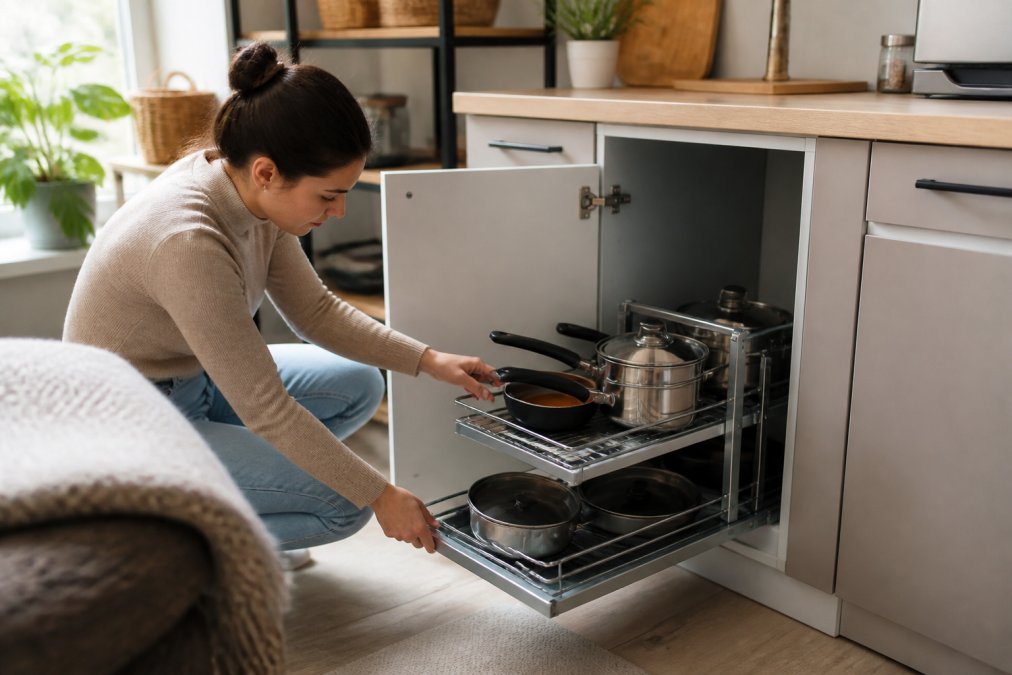
Pull Out Pots and Pans Organizer with 8 →
Budget-Friendly Kitchen and Entryway Organization
Kitchen and entryway clutter builds fastest because these are the two highest-traffic zones in a small apartment. Most guides tell you to "give everything a home." That advice is too vague to act on. The rental-friendly version is more specific: give every item a home within arm's reach of where you use it, using only damage-free hardware.
The Damage-Free Rule for Renters
Before you buy anything, set one constraint: nothing that requires drilling, wall anchors, or permanent adhesive that pulls paint. That single rule eliminates most of the expensive, lease-risky options and narrows your choices fast, which is the whole point when you are trying to avoid overwhelm.
Rental-safe tools that actually hold weight:
- Tension rods inside cabinets for stacking plates or separating baking sheets
- Adhesive hooks rated for the load, check the package rating, not the marketing photo
- Over-the-cabinet-door racks for cutting boards, wraps, and lids
- Stackable clear bins so you can see contents without unpacking
Kitchen: Zone It, Don't Reorganize It
Stop reorganizing the whole kitchen. Pick one zone per week and finish it. A workable sequence:
- Cooking zone, pots, pans, and utensils near the stove
- Prep zone, cutting boards, knives, and bowls near the main counter
- Storage zone, pantry and dry goods
- Cleanup zone, under the sink
Entryway: The Three-Item Cap
Entryway clutter disappears once you add a landing spot for keys, mail, and bags, and cap it at three items. More than three and the surface becomes a dumping ground again.
- One hook strip for keys and leashes (adhesive-backed for rentals)
- One small bin for shoes, sized so it cannot overflow
- One tray or basket for mail, emptied weekly
The Inventory Check That Prevents Re-Cluttering
Once a zone is done, do a 60-second weekly reset: return anything that drifted out of its zone. This is the inventory-management habit most guides skip. It costs nothing and is the difference between a one-time cleanup and a system that holds.
Rental-Friendly and Pet-Friendly Storage Solutions
Rental-friendly storage avoids permanent changes, so you get your deposit back. Pet-friendly storage adds one more rule: nothing a cat or dog can tip, chew, or knock over. Both goals point to the same tools.
- Use adhesive strips and tension rods instead of screws
- Choose closed bins so pets cannot reach the contents
- Pick washable fabrics for easy cleanup
- Skip open baskets for small, chewable items
Conclusion: Start With One Zone, Not the Whole Apartment
The biggest mistake in small apartment organization is trying to fix everything in one day. That is what creates the overwhelm in the first place. Pick one zone, run the 3-Box Method, and add one storage tool. Then stop.
Frequently Asked Questions
What is the 3-3-3 rule for decluttering?
The 3-3-3 rule is a simple decluttering framework: pick three items to throw away, three to donate, and three to put back in their proper place. It works well for small apartment organization because it breaks the overwhelming task into a 15-minute session. You do not need to empty entire closets or cabinets. Just work through one drawer or shelf at a time. Repeat the cycle daily or weekly until you have covered each zone in your apartment. The small wins build momentum without decision fatigue.
What are the best budget-friendly storage solutions for small spaces?
Collapsible fabric bins, over-the-door organizers, wall-mounted shelves, and stackable containers deliver the most storage capacity per dollar. A three-pack of fabric storage bins works in closets, under beds, or on shelves. Expandable drawer organizers, like a bamboo cutlery tray that adjusts from 7 to 9 compartments, keep kitchen drawers functional without permanent modifications. Look for multi-functional furniture and vertical storage options that use wall space you are not currently using. These small apartment storage hacks cost less than $50 each and move with you when you relocate.
How do you organize a small apartment when you have too much stuff?
Start with a purge before buying any storage products. Use the 3-box method: one box for keep, one for donate, one for trash. Work through one zone at a time, such as the entryway or kitchen counter, rather than trying to tackle the whole apartment in a weekend. Once you have reduced what you own, add budget-friendly organizers like under-bed bins or a pull-out cabinet organizer for pots and pans. The key is to declutter first so you are not buying containers for things you do not actually need.
How can I organize a rental apartment without losing my security deposit?
Choose non-permanent solutions that do not require drilling or wall damage. Adhesive strips, tension rods, over-the-door racks, and freestanding shelving units are all rental-friendly. A pull-out pots and pans organizer with adhesive strips installs tool-free and removes cleanly. Collapsible fabric bins fold flat when not in use and move easily to your next place. Focus on vertical storage and multi-functional furniture that works in different floor plans. Avoid anything that requires permanent mounting unless your lease explicitly allows it.