

Non-Toxic Pet-Safe Cleaning Products: A Buyer's Guide
Table of Contents
- Why Pet-Safe Cleaning Products Matter
- Understanding Pet-Safe Cleaning Products and What Makes Them Different
- Cleaning Products Toxic to Dogs and Cats: What to Avoid
- Pet-Safe Floor Cleaners: Protecting Your Hardwoods and Tile
- Pet-Safe Enzyme Cleaners for Stains and Odors
- Ingredients That Signal a Truly Pet-Safe Formula
- How to Use Pet-Safe Cleaners Safely: Storage, Dilution, and Ventilation
- Conclusion
- Frequently Asked Questions
Last Updated: October 7, 2026
Why Pet-Safe Cleaning Products Matter
Your home needs to be clean; your pets need to be safe. These goals don't have to compete.
Many pet owners reach for conventional cleaners without thinking twice. What the bottles don't mention is what those chemicals do to animals that walk across freshly cleaned floors, lick surfaces, or breathe fumes.
At PracticalHomeEssentials.com, we understand that a healthy home means choosing products that work without putting your pets at risk.
The challenge is knowing which products actually deliver. Marketing language misleads: "natural" doesn't always mean safe for pets, and "non-toxic" is sometimes overstated.
Understanding Pet-Safe Cleaning Products and What Makes Them Different
Pet-safe cleaning products are formulas designed to eliminate dirt, stains, and odors without using ingredients known to harm dogs, cats, birds, or other common household pets.
The difference comes down to ingredient selection. Conventional cleaners often contain ammonia, bleach, phenols, or synthetic fragrances that trigger respiratory problems, skin irritation, or organ damage in animals.
This doesn't mean pet-safe cleaners are weak.
The real difference shows up over time. A pet repeatedly exposed to conventional cleaners may develop chronic coughing, skin conditions, or behavioral changes owners attribute to age or allergies. Switching to pet-safe products eliminates these hidden exposures.
Cleaning Products Toxic to Dogs and Cats: What to Avoid
Before you can choose safe products, you need to know what to keep away from your pets.
Ammonia-based cleaners are common and dangerous. Found in glass cleaners, bathroom tile products, and all-purpose sprays, ammonia triggers respiratory distress in cats especially and can damage their sensitive nasal passages.
Bleach is another major hazard, corrosive to skin and lungs. Bleach combined with ammonia creates lethal chlorine gas (the CDC).
Phenols appear in many disinfectants, floor cleaners, and wood polishes.
Synthetic fragrances and essential oils deserve special attention.
Pet-Safe Floor Cleaners: Protecting Your Hardwoods and Tile
Floors take the most direct hit from cleaning chemicals.
The best options use enzymatic or plant-based surfactants that break down oils and dirt without leaving residue that accumulates with repeated use. Look for products that rinse cleanly with water.
For hardwood, be cautious: many cleaners contain wax or silicone that builds up and becomes slippery, a hazard for pets with older joints or mobility issues.
Always rinse thoroughly after cleaning any floor. Even pet-safe products can irritate paws if left as residue, so dry the floor before letting your pet back in.
Pet-Safe Enzyme Cleaners for Stains and Odors
Enzyme cleaners solve a problem no other cleaner handles as well: pet accidents.
When a dog or cat has an accident on carpet or furniture, the urine soaks into fibers and padding, where bacteria break it down into compounds that smell worse over time.
Enzymes are proteins that break apart specific molecules. In pet-accident cleaners, they target uric acid and ammonia compounds, converting them into harmless substances.
PracticalHomeEssentials.com carries a Pet Stain & Odor Remover designed specifically for this job. At $17.99, it offers enzyme-based cleaning that works on carpets, upholstery, and hard floors.

Ingredients That Signal a Truly Pet-Safe Formula
Reading a label separates marketing from reality, but only if you know what each ingredient does, how a pet could be exposed, and whether risk differs by species.
| Ingredient | Where it shows up | Main exposure route | Species most at risk |
|---|---|---|---|
| Ammonia and ammonium compounds | Glass cleaners, bathroom sprays, all-purpose sprays | Inhalation of fumes; paw contact with residue | Cats (respiratory and nasal irritation); birds (very sensitive to airborne irritants) |
| Chlorine bleach (sodium hypochlorite) | Disinfectants, laundry additives, tile cleaners | Ingestion of residue; inhalation; skin contact | Dogs and cats (mouth and throat burns, vomiting); birds (fumes) |
| Phenols and phenolic disinfectants | Floor cleaners, disinfectant sprays, wood polishes | Skin contact; grooming after walking on residue; ingestion | Cats (lack key liver enzymes to metabolize phenols); reptiles and amphibians |
| Quaternary ammonium compounds (quats) | Disinfecting wipes, floor cleaners, fabric sprays | Skin and paw contact; ingestion during grooming | Cats and dogs (skin irritation, GI upset at higher exposures) |
| Phthalates (often hidden under "fragrance") | Scented sprays, laundry products, air fresheners | Inhalation; skin contact; ingestion of residue | Cats (hormone disruption concerns); birds (respiratory) |
| Essential oils (eucalyptus, tea tree, citrus, peppermint, wintergreen) | "Natural" sprays, floor cleaners, DIY mixes | Inhalation; skin contact; ingestion; grooming | Cats (cannot efficiently metabolize many terpenes); birds; rabbits and other small mammals |
| Ethanol and isopropyl alcohol | Disinfecting sprays, glass cleaners | Inhalation; ingestion | Birds and small mammals (rapid absorption, small body mass) |
| Sodium benzoate, potassium sorbate | Preservatives in liquid cleaners | Ingestion of residue | Generally low concern at label concentrations; still rinse food-contact surfaces |
| Plant-derived surfactants (coconut-, sugar-, corn-derived) | All-purpose cleaners, dish soaps | Ingestion of residue; skin contact | Low concern at diluted use; concentrated product can still cause GI upset if ingested |
| Enzymes (protease, lipase, amylase) | Pet-accident and odor removers | Skin contact; inhalation of aerosolized powder | Low concern once dry; some pets react to aerosolized enzyme powder during application |
How exposure actually happens. Most pet exposures are not dramatic. They are paw contact with damp floors followed by grooming, licking a countertop that was wiped but not rinsed, or inhaling fumes in a closed bathroom.
What the absence of an ingredient tells you. A genuinely pet-conscious formula typically omits ammonia, chlorine bleach, phenols, quats at disinfectant strength, undisclosed "fragrance," and the essential oils listed above. A precaution like "keep pets away until dry" signals the manufacturer expects residue to matter, not that the product is unsafe when used correctly, but that rinsing and drying are not optional.
A note on "fragrance." Under U.S. labeling rules, the single word "fragrance" can stand in for dozens of compounds, including phthalates.
How to Use Pet-Safe Cleaners Safely: Storage, Dilution, and Ventilation
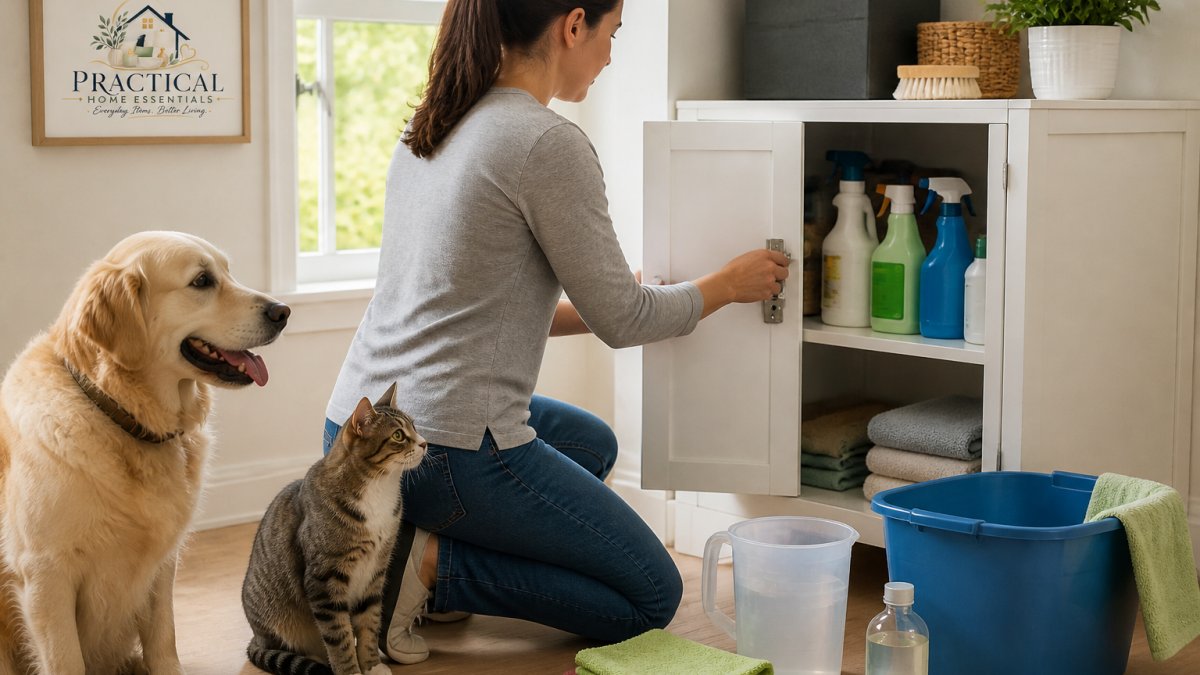
Choosing a pet-safe product is only half the job. How you dilute, apply, rinse, and store it determines how much residue your pet actually encounters.
Practical comparison criteria
When you compare two pet-safe cleaners, use the same criteria every time:
- Surface compatibility. Vinegar-and-water is fine on sealed hardwood and tile but can dull natural stone such as marble or travertine. Enzyme cleaners are safe on most carpets and upholstery but should be spot-tested first.
- Dilution ratio. Concentrates cost less per use but require measuring; ready-to-use products cost more per ounce but remove the risk of under-diluting and leaving residue.
- Rinse requirement. Even no-rinse products should be rinsed with plain water on any surface a pet touches.
- Scent and residue. Fragrance-free formulas reduce respiratory irritation in cats, birds, and pets with allergies. A sticky residue after drying usually means the product was over-concentrated or not rinsed.
- Cost per use. A 32-ounce concentrate that makes several gallons is often cheaper per cleaning than a ready-to-use spray. Compare on cost per use, not sticker price.
- Label precautions. A "keep pets away until dry" warning is a practical instruction, not a red flag.
Storage
Keep every cleaning product, including pet-safe ones, in a cabinet or closet a pet cannot open. Even low-toxicity formulas can cause vomiting or diarrhea if a pet drinks a meaningful amount, so use a childproof latch if your pet opens cabinets. Store products in their original labeled containers, never in unmarked spray bottles or food containers.
Dilution
Follow the label ratio exactly. Over-diluting reduces cleaning power and leaves organic matter that feeds odor-causing bacteria; under-diluting leaves more residue for paws and tongues to pick up. For a vinegar-and-water solution, a common ratio is roughly one part white vinegar to one part water, but check the surface first because acid can etch stone and some finishes. When in doubt, mix weaker and clean twice.
Ventilation and drying
Open a window or run a fan while you clean, even with low-odor products, airborne compounds matter most for birds and small mammals. After cleaning, keep pets out until surfaces are dry to the touch: often 30 to 60 minutes on a hard floor with good airflow, longer on carpet or in a humid bathroom. A damp floor is the most common way pets pick up cleaner residue on their paws and ingest it while grooming.
Rinsing
Rinse any surface your pet contacts with plain water after cleaning. For floors, go over the area with a clean damp mop or cloth; for countertops, food bowls, and water bowls, rinse and let air dry. This removes the residue that would otherwise transfer to paws, fur, and mouths.
If a pet is exposed
- Skin or paw contact: Rinse with lukewarm water and prevent grooming until rinsed. Watch for redness, swelling, or excessive licking.
- Ingestion: Remove the pet from the product, offer fresh water, and call a veterinarian or animal poison control with the label ready. Do not induce vomiting unless instructed.
- Inhalation: Move the pet to fresh air immediately. For birds and small mammals, treat any respiratory signs as urgent.
- Eye contact: Flush with plain water and contact a veterinarian.
Cleaning versus disinfecting
These are different tasks, and pet-safe products do not always do both. Cleaning removes dirt, oils, and organic matter; disinfecting kills or inactivates pathogens and usually requires a product that stays wet for a specified contact time. A vinegar-and-water solution is a reasonable everyday cleaner, but it is not a registered disinfectant and should not be relied on after a pet has vomited, had diarrhea, or been sick in the area. For those situations, follow your veterinarian's guidance on the appropriate disinfectant for your pet, and keep the animal out until the surface has been cleaned, disinfected, thoroughly rinsed, and dried.
Conclusion
Creating a clean home and keeping your pets safe aren't competing priorities, pet-safe cleaning products deliver both. The key is knowing which ingredients to avoid, choosing formulas designed for households with animals, and using them correctly through proper storage, dilution, and rinsing.
When you're ready to switch, start with the products you use most frequently: your floors and your pet's favorite resting spots. PracticalHomeEssentials.com's Pet Stain & Odor Remover provides enzyme-based cleaning that handles accidents and odors without toxic ingredients, giving you a solution that works for both your home and your pets.
Frequently Asked Questions
What cleaning products are safe to use around pets?
Pet-safe cleaning products contain non-toxic ingredients like plant-based surfactants, vinegar, lemon, and enzymes that break down stains without harming dogs or cats. Look for products labeled pet-safe or non-toxic, and avoid anything containing ammonia, bleach, phenols, or essential oils like tea tree. Our Pet Stain & Odor Remover uses enzyme-based formulas specifically designed to neutralize pet accidents safely.
Are enzyme cleaners safe to use around dogs and cats?
Yes, pet-safe enzyme cleaners are generally safe for dogs and cats when used as directed. Enzymes break down organic matter (urine, feces, vomit) at a molecular level without toxic residue. Always follow label directions, ensure proper ventilation, allow surfaces to dry completely before pet contact, and store the product where pets cannot access it. Enzyme-based formulas are especially effective for pet accidents because they eliminate odor-causing compounds that pets can smell.
What ingredients should pet owners avoid in cleaning products?
Avoid ammonia, bleach, phenols, d-limonene (citrus extract), tea tree oil, and xylene. These chemicals can cause respiratory irritation, neurological damage, or organ toxicity in pets even at low exposures. Read product labels carefully and check ingredient lists, not just marketing claims. If a product doesn't list ingredients, contact the manufacturer or skip it. Natural-sounding names can hide harmful compounds, so verify actual chemical content rather than relying on eco-friendly marketing language.
Which pet-safe cleaner works best on urine stains and odors?
Enzyme-based cleaners specifically formulated for pet accidents outperform general-purpose cleaners because enzymes target the compounds that cause odors. Products containing protease and amylase enzymes break down urine proteins and salts at the source. For best results, apply the cleaner to the affected area, allow it to sit per product instructions (usually 10-30 minutes), then rinse thoroughly. Our Pet Stain & Odor Remover ($17.99) uses this enzyme approach and is formulated to be safe for all pet types while actually eliminating odors rather than masking them.