

How to Style Apartment Living Rooms: A Practical Guide
Table of Contents
- Assess Your Space and Set a Layout Foundation
- Small Apartment Layout Ideas That Actually Work
- Choose Multi-Functional Furniture for Small Spaces
- Build Your Color Palette and Add Textural Contrast
- Layer Lighting to Set Mood and Function
- Rental-Friendly Wall Decor Ideas That Transform Your Space
- Style Your Living Room on a Budget Without Compromise
- Common Mistakes to Avoid When Styling Your Apartment
- Frequently Asked Questions
Last Updated: September 24, 2026
Assess Your Space and Set a Layout Foundation
Before you buy a single piece of furniture for style apartment living rooms, measure your living room. Grab a tape measure and document the dimensions, note where windows and doors are, and identify any architectural quirks, exposed pipes, radiators, or odd angles. This foundation determines everything that follows.
Layout is the invisible force that makes or breaks a space. A poorly placed sofa cuts your room in half; strategic placement opens it up.
Identify your traffic flow, where do people naturally walk? Work with that path, not against it. Your furniture should guide people through the space, not force them around obstacles.
Establish a focal point, a window, fireplace, or gallery wall. Arrange seating to orient toward it. This anchor makes the room feel intentional and finished.
Small Apartment Layout Ideas That Actually Work
Prioritize multi-functional zones within a single room. Divide your living room into distinct areas: seating, work (if applicable), and storage.
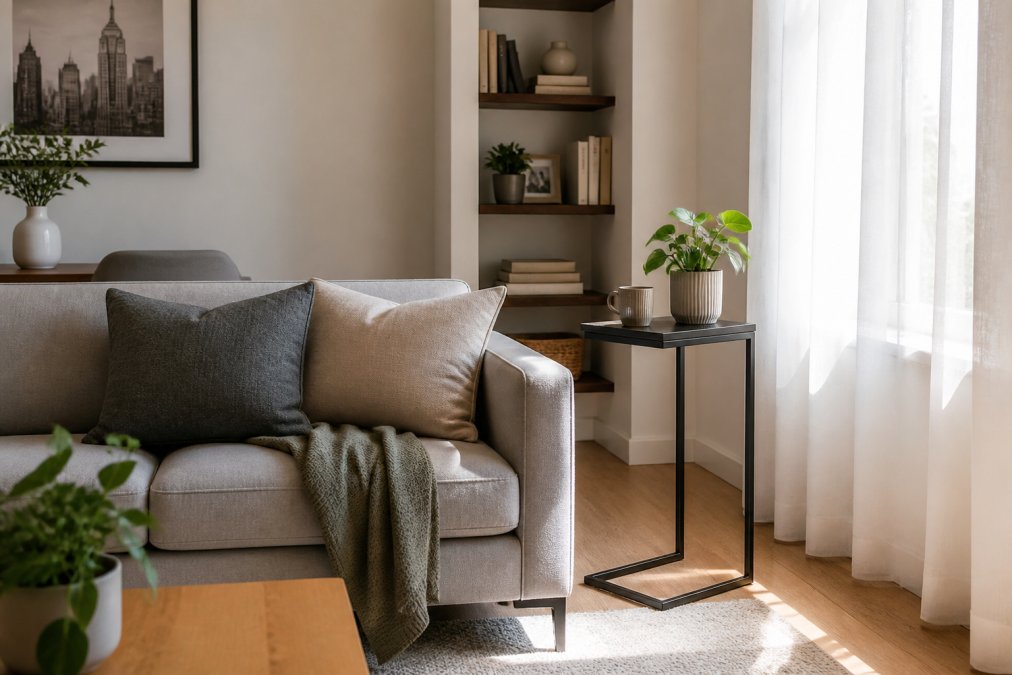
Float your seating area in the center of the room instead of pushing everything against walls. This creates defined zones and makes the space feel larger. Pair a compact sofa with a small ottoman or accent chair angled to encourage conversation.
For awkward corners, try an L-shaped arrangement: position a sofa along the longest wall and add a small accent chair perpendicular to it.
For renters, modular furniture offers flexibility. A two-piece sectional can become separate pieces in your next space; a side table with storage can migrate between rooms.
Maximize vertical space. Wall-mounted shelves, tall bookcases, and floor-to-ceiling storage create the illusion of more square footage while storing books, plants, and decor.
Choose Multi-Functional Furniture for Small Spaces
Multi-functional furniture is the entire strategy for small spaces. Every piece should serve at least two purposes.
An ottoman with hidden storage serves as footrest, coffee table, and storage. A console table behind a sofa creates a work surface or display area. Wall-mounted desks fold away, transforming your living room between work and living zones.
The C-Shaped Side Table with Faux Marble Top and Storage Shelf exemplifies this principle. Its low-profile design slides under sofas while two-tier storage holds lamps, books, and decor. The faux marble top adds sophistication without bulk, designed for apartments where every inch matters.

Sofa beds, Murphy beds, and storage benches serve double duty for sleeping and seating.
Prioritize pieces that don't announce their secondary function. The best look like finished furniture first and practical storage second.
Build Your Color Palette and Add Textural Contrast
Light, neutral tones reflect light and create an airy feeling. Depth comes from textural contrast, not bold colors.
Choose two neutral tones for walls and large furniture, then introduce one or two accent colors through textiles and decor. This prevents visual overwhelm while allowing personality to shine.
Textural contrast brings small apartments alive. Pair sleek leather with chunky knit, smooth glass with woven rugs, polished marble with matte paint.
The Fennco Styles Rhombus Diamond Knit Modern Fringe Throw demonstrates textural layering. Its geometric knit pattern and fringe add visual interest and warmth without consuming floor space.

Incorporate natural materials: wood, jute, linen, and wool. A jute rug grounds the seating zone; wooden shelving adds warmth; linen pillows soften edges.
Layer Lighting to Set Mood and Function
Layered lighting, ambient, task, and accent, transforms small apartments. Color temperature determines whether your living room feels cozy or clinical.
Ambient lighting provides overall illumination. Don't rely solely on overhead lighting; it's often too harsh.
Task lighting handles reading, working, or detailed activities. A floor lamp or desk lamp provides focused illumination without lighting the entire room.

Understanding Color Temperature for Living Room Zones
Color temperature is measured in Kelvin (K). The lower the number, the warmer (more orange-yellow) the light. The higher the number, the cooler (more blue-white) the light.
C-Shaped Side Table with Faux Marble →
- 2700K (Warm White): Resembles incandescent bulbs. Creates relaxation and intimacy. Best for seating areas, reading nooks, and evening spaces. This is your default for living rooms where people unwind.
- 3000K (Neutral Warm): A bridge between warm and cool. Works in multipurpose zones where you both relax and handle tasks. Suitable for console tables used for occasional work or hobby activities.
- 3500K-4000K (Neutral to Cool White): Increases alertness and focus. Use this only in dedicated work zones if your living room doubles as a home office. Avoid in primary seating areas after 6 PM, as it suppresses melatonin and disrupts sleep.
- 5000K+ (Daylight/Cool White): Mimics midday sun. Rarely appropriate for living rooms; reserve for task-specific work areas only.
Practical Mapping for Apartment Living Rooms
In a typical apartment living room, layer your lighting by temperature zone:
-
Seating area (2700K): Your sofa, armchairs, and coffee table should be lit with warm bulbs. This is where people spend the most time. A floor lamp with a 2700K bulb beside a reading chair creates an inviting focal point.
-
Accent/display lighting (2700K-3000K): Gallery walls, floating shelves, and plants look best under warm accent lighting. LED strip lights behind shelves set to 2700K enhance visual interest without creating glare.
-
Work zone, if applicable (3000K-3500K): If your living room includes a console desk or work surface, use a task lamp with a 3000K bulb. Position it to avoid glare on screens. Keep this zone visually separated from the seating area so the cooler light doesn't bleed into your relaxation space.
-
Overhead/ambient (2700K): If you have ceiling fixtures, install 2700K bulbs. Use dimmer switches to reduce intensity in the evening. Dimmed warm light at 40-50% brightness creates ambiance while maintaining functionality.
The Austin Floor Lamp serves both purposes. Its vintage-inspired design works as a style statement while providing warm task lighting. Position it beside a seating area for reading or behind a console table for work-from-home setups. The hanging glass shade diffuses light softly, avoiding the harsh glare of direct bulbs. Verify the bulb type supports 2700K for seating zones.
Practical Implementation Tips
Check whether your lamps use standard E26 sockets or specialty bases. Smart bulbs let you adjust color temperature throughout the day without replacing bulbs.
For renters unable to replace ceiling fixtures, layer floor and table lamps strategically. Three well-placed 2700K lamps outperform a single overhead fixture.
Rental-Friendly Wall Decor Ideas That Transform Your Space
Renters hesitate to personalize walls, fearing damage deposits. Rental-friendly wall decor transforms your space without permanent changes while solving noise and echo problems.
Removable Wall Treatments for Style and Sound
Removable wallpaper and peel-and-stick murals add pattern and color without commitment. They also dampen sound reflection, textured walls absorb noise better than bare ones.
Fabric wall hangings and tapestries absorb sound frequencies, reducing echo.
Gallery Walls: Aesthetic and Acoustic Impact
Floating Shelves: Display and Sound Management
Acoustic Panels Disguised as Decor
Combining Rental-Friendly Treatments for Maximum Impact
Style Your Living Room on a Budget Without Compromise
Budget constraints force creativity. Necessity drives intentionality in the most stylish small apartments.
Common Mistakes to Avoid When Styling Your Apartment
Overcrowding is the most common error. Before adding anything, ask: does this serve a function or add genuine beauty?
Frequently Asked Questions
What is the 3-5-7 rule in decorating apartment living rooms?
The 3-5-7 rule is a design principle for styling apartment living rooms with visual balance. Use 3 accent pieces in one color, 5 pieces in another, and 7 in a neutral base color. This creates a cohesive look without overwhelming small spaces. For example, pair 3 throw pillows in teal, 5 accessories in warm wood tones, and 7 neutral textiles like a rug or curtains to anchor your scheme and maintain proportional harmony.
How do I make a small apartment living room look bigger?
To make a small apartment living room appear larger, use vertical storage to draw the eye upward, choose multi-functional furniture that reduces visual clutter, and apply a light color palette with textural contrast. Position your focal point, such as a gallery wall or accent piece, to create depth. Mirrors and layered lighting also expand the sense of space. Strategic furniture placement that maintains clear traffic flow prevents the room from feeling cramped.
What are the best ways to create multi-functional zones in a small apartment?
Create distinct zones using area rugs, lighting, and furniture arrangement rather than walls. A rug under your seating area defines the living space, while a side table with task lighting can mark a work-from-home corner. Use modular furniture like ottomans or sofa beds that adapt to different activities. Shelving units can divide spaces visually without blocking light. This approach maximizes how to style apartment living rooms by making every square foot serve multiple purposes.
Can I style my apartment living room without making permanent changes?
Yes. Rental-friendly wall decor ideas include removable adhesive strips for hanging art, peel-and-stick wallpaper, and fabric wall hangings that don't damage paint. Avoid nailing or drilling whenever possible. Use freestanding shelving, area rugs, and furniture arrangement to define spaces. Throw pillows, blankets, and lighting create style without commitment. This approach lets you refresh your apartment living room aesthetic while keeping your security deposit intact and maintaining flexibility for your next move.