

Are High-Quality Kitchen Knives Worth It? Honest Verdict
Table of Contents
- Are High-Quality Kitchen Knives Worth the Investment? The Short Answer
- The Cost-Per-Use Calculation for Kitchen Knives
-
What Actually Makes a Knife High-Quality?
- The Steel: Composition Determines Performance Ceiling
- Heat Treatment: The Hidden Quality Differentiator
- Blade Geometry: Where Performance Actually Lives
- Forged vs. Stamped: The Real Difference
- How to Identify a Quality Blade Without Cutting Anything
- Steel Type: Carbon Steel vs Stainless Steel Knives
- The Practical Test: What You'll Notice in Daily Use
- Where the 'Diminishing Returns' Threshold Starts
- The Real Cost of Maintenance: How to Maintain Kitchen Knives
- Our Verdict: When to Spend and When to Save
- Frequently Asked Questions
Last Updated: September 5, 2026
Are High-Quality Kitchen Knives Worth the Investment? The Short Answer
High-quality kitchen knives are worth the investment for anyone who cooks regularly, but the value depends entirely on how often you cook and how well you maintain the blade.
A quality knife transforms daily cooking, but the calculation breaks down if you rarely cook or refuse to perform basic maintenance.

The Cost-Per-Use Calculation for Kitchen Knives
The most rigorous way to evaluate any long-term kitchen purchase is a cost-per-use model that accounts for the full lifecycle of the blade, including replacement cycles, sharpening expenses, and the opportunity cost of your prep time.
Let's build a realistic model for a home cook preparing dinner five nights a week (roughly 260 meals per year). Consider two scenarios: a budget stamped knife at $25 that needs replacement every two years, and a mid-range forged knife at $150 that lasts 15 years with proper care.
Scenario A: The Budget Blade ($25 every 2 years over 15 years)
- Purchase cost: $25 × 7.5 replacements = $187.50
- Sharpening: None (typically discarded when dull)
- Total 15-year cost: $187.50
- Cost per meal (3,900 meals): $0.048
Scenario B: The Quality Forged Knife ($150 once over 15 years)
- Purchase cost: $150
- Maintenance: One whetstone ($40) or professional sharpening at $10 per session, twice per year = $300 over 15 years
- Total 15-year cost: $490
- Cost per meal (3,900 meals): $0.126
This model misses two critical factors: the budget knife's performance degrades significantly in its second year, and the quality knife retains resale value and can be passed down, while the budget blade ends up in a landfill.
A more honest model includes the value of your time. If a dull budget knife adds just 3 minutes to each prep session (a conservative estimate), that's 13 hours per year lost. At a modest $15 per hour for your time, that's $195 annually, far exceeding the cost difference between the two blades.
The Real Break-Even Point
The math shifts dramatically based on cooking frequency. A daily cook who prepares 400+ meals annually will cross the cost-per-use break-even point between a $150 knife and a $25 knife within 18 months. A weekly cook preparing 52 meals per year won't reach that break-even for over 7 years, at which point the budget knife has been replaced 3 times anyway.
| Cooking Frequency | Meals Per Year | Break-Even Period ($150 vs $25 knife) | Recommendation |
|---|---|---|---|
| Daily (5-7 nights/week) | 260-365 | 1.5 - 2 years | Invest in quality |
| Frequent (3-4 nights/week) | 156-208 | 2.5 - 3.5 years | Invest if you maintain |
| Weekly (1-2 nights/week) | 52-104 | 5 - 7 years | Mid-range is sufficient |
| Occasional (monthly) | 12-24 | 15+ years | Budget blade is fine |
A $25 stamped knife typically cannot be sharpened effectively at home because the steel is too soft to hold an edge. A $150 forged knife with high-carbon stainless steel (like VG-10 or AUS-10) can be sharpened 50-100 times over its life, spreading the $40 whetstone investment across decades.
Professional sharpening services charge $8-$15 per knife; sending your knife out twice per year costs $20-$30 annually. Learning to use a whetstone (a 2-hour skill investment) eliminates this recurring cost entirely.
For the daily cook, a quality knife is cheaper per meal than a budget blade within two years. For the occasional cook, the budget blade wins on raw numbers, but the quality knife still delivers a better cooking experience.
What Actually Makes a Knife High-Quality?
The Steel: Composition Determines Performance Ceiling
The blade steel's chemistry sets the upper limit for edge retention, toughness, and corrosion resistance. Most quality knives use high-carbon stainless steel, which balances edge-holding ability with rust resistance. Common alloys include:
- VG-10 (Japan): Contains 1% carbon and 1% vanadium. Holds a fine edge well, slightly brittle. Found in many mid-to-premium Japanese knives.
- AUS-10 (Japan): Similar to VG-10 but with added molybdenum for toughness. More forgiving for home cooks who might hit bones or frozen food.
- X50CrMoV15 (Germany): A softer steel (Rockwell hardness around 56-58 HRC) used by Wusthof and Zwilling. Easier to sharpen, but requires more frequent honing.
- SG2 / R2 (Japan): A powder metallurgy steel reaching 62-63 HRC. Exceptional edge retention but requires diamond or ceramic sharpening stones.
Hardness is measured on the Rockwell C scale (HRC). A harder blade (60+ HRC) holds an edge longer but is more brittle and harder to sharpen; a softer blade (56-58 HRC) is more forgiving but dulls faster. The sweet spot for most home cooks is 58-61 HRC.
Heat Treatment: The Hidden Quality Differentiator
Two knives made from identical steel can perform completely differently based on heat treatment, the blade must be heated, quenched, and tempered in a controlled process that optimizes the steel's crystalline structure.
You cannot visually inspect heat treatment quality; your only signals are brand reputation, third-party testing, and real-world edge retention.
Blade Geometry: Where Performance Actually Lives
Beyond steel, the blade's geometry determines how it cuts. Key measurements include:
- Edge angle: Western knives typically use a 20-degree edge per side; Japanese knives often use 15 degrees. A thinner edge angle cuts more easily but chips more readily.
- Blade thickness behind the edge: A blade that tapers dramatically from spine to edge (distal taper) reduces friction and improves food release. Cheap knives often have uniform thickness, making them wedge through dense vegetables.
- Blade profile: A curved belly (German style) allows a rocking chop motion; a flatter profile (Japanese gyuto) excels at push-cutting and slicing.
Forged vs. Stamped: The Real Difference
Forged blades are heated and shaped from a single steel billet; stamped blades are cut from a rolled sheet of steel. Modern manufacturing has narrowed the performance gap considerably.
- Full tang: The steel extends through the entire handle. This provides balance and prevents the blade from loosening over years of use. Most quality knives (forged or stamped) have full tangs.
- Heat treatment quality: A well-treated stamped blade outperforms a poorly-treated forged blade.
- Edge geometry: Whether forged or stamped, the blade must be ground to a consistent, thin edge.
How to Identify a Quality Blade Without Cutting Anything
Before buying, run these checks:
- Balance test: Hold the knife at the bolster (where blade meets handle). A well-balanced knife should feel neutral, not tipping forward or backward.
- Spine feel: Run your finger along the spine. It should be smooth, not sharp or rough. A sharp spine indicates poor finishing.
- Blade symmetry: Look down the blade from the tip. The edge should be centered, not biased to one side.
- Handle attachment: Check for gaps between handle and tang. Quality knives have seamless joins with no visible glue or seams.
- Weight distribution: A quality knife should feel substantial but not heavy. Most chef's knives weigh between 7-10 ounces. Heavier doesn't mean better, it means more fatigue during long prep sessions.
Steel Type: Carbon Steel vs Stainless Steel Knives
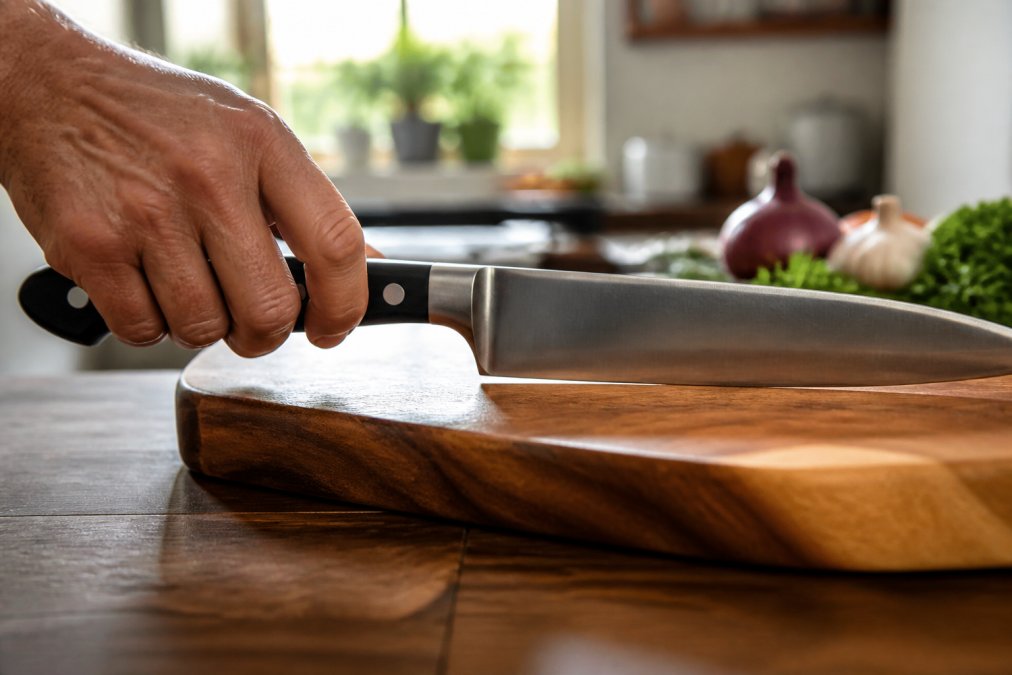
Carbon steel (often 1095 or white steel in Japanese knives) takes an exceptionally sharp edge and holds it well, but it reacts with acidic foods, develops a reactive patina, and rusts if not dried immediately after washing.
Modern high-carbon stainless alloys (like VG-10 and AUS-10) close most of the performance gap while eliminating rust anxiety. For 95% of home cooks, stainless steel is the rational choice.
The Practical Test: What You'll Notice in Daily Use
A quality knife reveals itself within the first few minutes of use. It should:
- Slice through a tomato without crushing it (tests edge sharpness and geometry)
- Chop an onion without requiring excessive downward force (tests blade weight and balance)
- Feel stable in your grip during a rock chop (tests handle ergonomics)
- Not flex when pressing down on a hard vegetable (tests blade stiffness)
If a knife fails any of these tests, its price tag is irrelevant. Quality is a functional property, not a marketing claim.
Where the 'Diminishing Returns' Threshold Starts
The diminishing returns threshold in kitchen knives begins where you start paying for brand cachet, exotic handle materials, and collector appeal rather than meaningful cutting improvement.
Most home cooks find their sweet spot in the mid-range segment. The performance gap between a budget knife and a mid-range option is enormous; the gap between mid-range and ultra-premium is barely noticeable except to professional chefs.
A beginner cook cannot extract the performance benefits of an ultra-premium blade because their technique limits what the knife can do.
The Real Cost of Maintenance: How to Maintain Kitchen Knives
A neglected premium blade performs worse than a well-maintained budget knife. The ongoing costs of sharpening equipment, cutting boards, and proper storage should factor into your decision.
Regular honing with a honing rod realigns the blade edge between sharpenings. When the edge eventually dulls, you need a whetstone, pull-through sharpener, or professional services. Budget knives often get discarded when dull because replacement costs less than sharpening equipment.
The America's Test Kitchen guide on knife care emphasizes that proper storage is equally important. Loose knives in a drawer dull quickly and pose a safety hazard. A knife block, magnetic strip, or blade guards protect both the edge and your fingers. Wooden and fiberwood cutting boards are gentler on edges than glass or stone surfaces, preserving your sharpening investment longer.
A practical approach to maintenance cost analysis: budget for a sharpening tool and a quality cutting board alongside your knife purchase. The USDA food safety guidance on kitchen hygiene reminds cooks that non-porous, dishwasher-safe cutting boards reduce cross-contamination risk, making them a worthwhile companion to any quality blade. These supporting purchases add to the upfront cost but protect your knife investment over time.
Our Verdict: When to Spend and When to Save
Spend on a quality knife if you cook several times per week, value precision cutting, and will commit to basic maintenance. Save your money if cooking is occasional or you have no interest in honing and sharpening routines.
For most home cooks, the smart play is buying one quality chef's knife rather than a full set. A single versatile blade handles the majority of kitchen tasks, and the savings can fund a proper sharpener and cutting board. The Consumer Reports guidance on knife sets consistently finds that most home cooks reach for one or two knives, making full sets a poor allocation of budget.
| Scenario | Recommendation | Rationale |
|---|---|---|
| Daily cook, willing to maintain | Invest in forged knife | Lowest cost-per-use over time |
| Weekly cook, basic needs | Mid-range stamped knife | Good performance, fair price |
| Occasional cook, tight budget | Budget knife, replace as needed | Avoids sunk cost in unused tool |
| Gift for a serious cook | Premium blade + sharpener | Practical, long-term value |
For those ready to protect their investment, PracticalHomeEssentials.com carries the Professional Knife Sharpener 4 Stages Stone Tungsten Diamond Ceramic Tool at $12.00, a four-stage system with tungsten, diamond, and ceramic stones that keeps any blade in peak condition. Pair it with the Classic Series 3 Piece Cutting Board Set at $99.99, a USA-made, NSF-certified fiberwood set that is knife-friendly, non-porous, reversible, and heat-resistant up to 350°F.

Choosing whether high-quality kitchen knives are worth the investment comes down to your cooking frequency, maintenance willingness, and budget priorities. PracticalHomeEssentials.com offers free shipping on the sharpening tools and cutting boards that protect your knife investment.

Frequently Asked Questions
How much should you spend on a good kitchen knife?
For most home cooks, the $50 to $150 range for a single chef's knife offers the best balance of performance and value. This price bracket typically gets you a fully forged blade with good steel. Spending more than $200 starts showing diminishing returns that only experienced cooks might notice. A quality $75 knife, maintained properly, will outperform a $200 knife that is never sharpened.
Do expensive kitchen knives stay sharp longer?
Yes, generally a high-quality knife made from harder steel will hold its factory edge longer than a cheap stamped blade. However, no knife stays sharp forever. The difference is that premium steel can be sharpened to a finer edge and will resist dulling through normal use. A good whetstone or sharpening tool is still necessary for all kitchen knives worth the investment.
What is the difference between forged and stamped knives?
Forged knives are cut from a single piece of heated steel, making them heavier, more durable, and better balanced. Stamped knives are cut from a rolled sheet of steel, making them lighter and cheaper to produce. Forged blades generally offer better performance and longevity, but a high-quality stamped knife can still be a smart budget pick for a first apartment.
Is it better to buy a knife set or individual pieces?
Most professional chefs recommend buying individual knives rather than a full set. A quality chef's knife, a paring knife, and a serrated bread knife handle 90% of kitchen tasks. Investing your budget in one excellent chef's knife is a better use of funds than buying a 12-piece set where most blades go unused and are often lower quality.
This article was written using GrandRanker